Brave New World
A classic science fiction novel that's sadly relevant today.
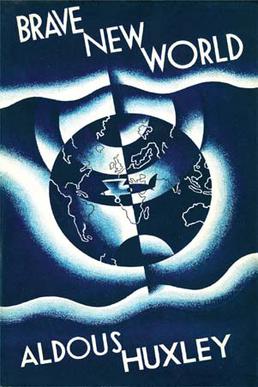
Brave New World describes a scenario where a progressive industrialized world state covers large swaths of the Earth. It’s primary goal: happiness and stability through social control. Ideal, right? No, it’s a nightmare.
This new “better” world has very different mores than our own. The word “mother” is taboo: human reproduction by natural means has been replaced with a scientifically controlled process. Embryos are manipulated to generate different castes: Alphas, Betas, Deltas, Gammas, and Epsilons. Some are reared for leadership, others for menial labor. The latter are intentionally stunted both physically and intellectually.
All are conditioned through subliminal messaging. The goal: accepting their lot in life and not striving for the alternatives, which would cause strife. Biological needs are provided for. Entertainment is exclusively superficial: titillating and devoid of meaning. There are synthetic — new! improved! — versions of everything, from music to flour. All remaining unpleasantness is sanded off by casual (and frequent!) use of a powerful drug called soma.
Mindless consumption is pushed as a positive, since it drives industrial productivity: people are encouraged to dispose of goods rather than repair them. Religion has been replaced with a worship of progress through efficiency, centered on Henry Ford. The “civilized” world’s calendar now starts with Ford’s birth: the novel takes place in AF (After Ford) 632. All references to “Our Lord” have been replaced with “Our Ford.”
Gender and sexual norms are also very different from those of 1932. Women and men enjoy greater equality and promiscuity is encouraged. There are no lifelong pairings: “everyone belongs to everyone.” But individuality is also discouraged: people are conditioned to loathe loneliness. Religious rituals have been replaced with communal gatherings that encourage ego dissolution.
I’m already deep into this description without mentioning a plot. That’s not an accident. While the novel does have one, it’s mostly in service to sketching the scenario. John, the novel’s ostensible protagonist, is an outcast: born (the old-fashioned way) to Linda, a citizen of the World State who’s accidentally left behind in a native American reservation.
As a result, he’s been raised with many of the foibles of the old world: a melange of religious superstitions, suboptimal diet and hygiene, and — critically, Shakespeare. (The book’s title — a phrase often repeated in the novel — comes from The Tempest.) Two progressive characters — Bernard Marx and Lenina Crowne — bring John to London. Through the ensuing culture clash, we recoil at the obvious failings of this dehumanized society.