Are you more of an analytical or a holistic thinker? The answer might depend on the culture in which you were raised — and will impact your ability to gain traction.
In episode 44 of Traction Heroes, Harry read a short segment from Joseph Henrich’s The WEIRDest People in the World, which argues that people in “WEIRD” societies — Western, Educated, Industrialized, Rich, and Democratic — tend to think more analytically than holistically.
I haven’t read the book, but do believe our culture influences our worldview — including how we think of timeframes and outcomes. If we’re driven by quarterly results, we’ll have a very different orientation than if we have a 10-year outlook.
Learning how culture affects our perspective changes how we understand ourselves and how we communicate with others — and both affect our ability to gain traction.
]]>Jorge ArangoWhen Meta-work Becomes the Work2026-08-28T00:00:00-07:002026-08-28T00:00:00-07:00https://jarango.com/2026/08/28/when-meta-work-becomes-the-workIn Duly Noted, I warned of the allure of meta-work: the work we do to enable “real” work. Writing a paper is work; setting up and maintaining your writing environment is meta-work. Meta-work is important, but fiddling with tools is an occupational hazard. At least it was, until AI agents came along.
I’ve wasted countless hours testing new to do apps, distraction-free editors, Obsidian plugins, citation managers, read-it-later apps, etc. Each promises to unlock productivity. Some might, but in aggregate they don’t make up for the time wasted. Worse, meta-work creates the illusion of progress while accomplishing little.
AI agents change that equation. I’ve been migrating many of my workflows to agents running on Claude Code, OpenCode, and Codex. Setting up and optimizing them is meta-work, but it’s of a different kind than learning a new text editor. Investing in this kind of meta-work isn’t a waste of time.
For one, these “tools” (the agents) will be the ones doing the work (under my guidance, obviously). The more time I spend improving them can yield better work down the line. (I’m reminded of the (apocryphal?) Lincoln quote: “If I had eight hours to chop down a tree, I’d spend six hours sharpening my ax.”)
But there’s another reason why agentic meta-work is valuable: reflecting on my practice makes me a better practitioner. Building an agent to draw wireframes (for example) requires codifying techniques I’ve held tacitly for decades. Teaching an agent how to do it forces me to think about how I do it and why.
That’s a plus per se, but the resulting work is also different. I don’t just generate wireframes faster: the role of wireframes has changed. Before, I’d explore variations on paper before committing to Figma. Now, I can explore more possibilities at higher fidelity. Wireframes become a means for designing and not just communicating.
As I told a friend yesterday, I’m more excited about my practice now than I’ve been in over a decade. More of my work is evolving toward meta-work, but it’s valuable meta-work. Rather than fiddling with tools, it’s about architecting machine intelligence to better leverage my own.
This way of working requires a different approach. So far, the shift has taught me valuable lessons for steering agents. Here are three:
1. Assume Incompetence
Frontier LLMs are very powerful, but they won’t do things exactly as you’d like out of the box. You have to tell them, which will require codifying things you’ve taken for granted. Assume you’re dealing with a very capable intern who knows more than you do about many things, but not how you like things done.
You’ll need to explicitly state sequences of steps, intended outcomes, caveats, guardrails, and more. You’ll have to think about your work. How do you do things? Why do you do them like that? What’s the expected outcome? Get used to writing all this stuff down.
2. Plan for Continuous Improvement
But don’t assume it’ll happen in one go. There’s too much to capture, and the magnitude of the task might inhibit you. Instead, start with a minimal viable set of instructions and improve them as you see the agents’ results.
I end all my agent sessions with the following prompt:
What have we learned in this session?
When the agent responds, I ask it to selectively capture the resulting lessons either in the project’s AGENTS.md file or in the appropriate SKILL.md files. As a result, the agents’ understanding and abilities improve over time.
3. Structure the Context
As the previous lesson implies, agentic work requires structural distinctions. At a minimum, you’ll want dedicated directories for projects and system-wide agent skills. The former define particular contexts, whereas the latter define cross-context abilities.
For example, I have directories for individual client projects. These include information specific to each project: its goals, dates, actors, plans, content, structures, etc. But I also have directories for particular agent capabilities such as wireframing and building presentations, which apply across projects.
Everyone’s Now a Manager and a Teacher
The endgame isn’t automating myself out of the job. Instead, it’s allowing me to provide greater value to my clients. Drawing wireframes is a low-value activity. My time is better spent thinking about how to drive more sales or increase customer satisfaction or build a stronger brand presence.
I can’t provide high-value without low-value tasks, but that doesn’t mean I must do them myself. Agents can help, but they need supervision and instruction. We already know how to teach and manage people, and some of those skills transfer. But there are differences: working with AI requires more clarity and vigilance.
Whether your work entails design, business development, compliance, or a myriad other disciplines, more of your work will likely become meta-work soon. Consider where your work adds the most value and which parts can be automated. Then, start codifying the latter. The sooner you do it, the more prepared you’ll be to delegate.
How do you delegate authority while maintaining coherence? That was the question at the core of Traction Heroes episode 43. It’s especially tricky in large organizations.
Leaders can go about it one of two ways: top-down and bottom-up. The first is tricky, since there’s only so much leaders can do. The larger the org, the more likely they’ll lose touch with conditions on the ground. Bottom-up is preferable, but that’s where you risk incoherence. If everyone can do whatever they want, the org can drift.
That’s where principles help. A strong set can help organizations remain coherent while delegating decision-making. Leadership maintains the culture that allows the organization to accomplish its mission over time while pushing decisions to the levels closest to the work. It’s a principle I learned from Catholic social teaching called subsidiarity.
The father-and-son team of Charles and Chase Koch published a book earlier this year called Becoming a Principle-Driven Leader that explains their approach, which exemplifies subsidiarity. The book also offers 41 principles that have helped Koch Industries maintain coherence at scale. I read from one of them, appropriately called BOTTOM-UP VS. TOP-DOWN. Here’s a portion:
A top-down approach presumes those in control know what’s best for everyone else. Those at the top typically seek power, rely on one-size-fits-all approaches, and use detailed rules and coercion that stifle others. No matter how well-intentioned, a top-down approach only benefits those at the top.
A bottom-up approach respects the inherent worth of each person and unleashes creativity, initiative, and talent. When behavior is governed by this principle, the outcome exceeds what anyone could have planned or predicted. Everyone benefits when behavior is mostly governed by general principles rather than detailed rules, freeing individuals to use their gifts and knowledge to tackle problems and pursue opportunities.
The Kochs clearly favor bottom-up, as do I.
If I sounded a little defensive, it’s because Charles Koch is cast as something like a boogeyman in left-leaning social circles. But I’ve found much to agree with his and Chase’s approach, even if (as I noted in my reading notes) I had some qualms with the book.
Regardless of what you think of the Koch’s politics, it behooves you to approach this episode — and their book — with an open mind. There are interesting and practical ideas there.
]]>Jorge ArangoIncorruptible2026-08-22T00:00:00-07:002026-08-22T00:00:00-07:00https://jarango.com/readings/incorruptibleYou’ve heard this story many times. An entrepreneur starts a company with a passionate vision to change the world: giving people healthier food choices, marketing a revolutionary new technology, curing a chronic illness. Eventually, they lose control of the company to entities with less noble motives. The founder’s beautiful vision succumbs to destructive extraction.
It’s happened many times: Boeing selling out its engineering culture, Johnson & Johnson compromising its values, Whole Foods losing its independence, etc. Some cases (e.g., Boeing) result in the loss of human life. But the tragedy isn’t just that the mission is compromised: in many cases, the company also succumbs, taking with it jobs and investor and customer value.
Incorruptible argues it doesn’t need to be like this. Ries analyzes the forces that cause founders to lose control of their companies — primarily, what he calls “financial gravity”: the seemingly inexorable pull of near-term ROI. He then offers alternatives in the form of uncommon governance structures.
But uncommon doesn’t mean unprecedented: The book offers case studies of organizations that have succeeded in the market while preserving their integrity, including Costco, Novo Nordisk, Zeiss, Gitlab, and more. These organizations have held on to their values and mission despite the odds because they were structured to resist — and in some cases, take advantage of — the pull of financial gravity.
This is a timely book. Many people today are down on capitalism. But the worst aspects of our financialized economic context aren’t inherent to free markets. Instead, they represent a particular — and relatively new — approach to organizing the economy.
Incorruptible offers a blueprint for a better future: one that encourages entrepreneurship while reducing negative externalities. Today’s common reductionist governance (invariably framed as “best practices”) is a choice. If you’re an early-stage founder, it behooves you to read this book.
]]>Jorge ArangoUnfinishe Conversations: What Your Machines Should Do2026-08-14T00:00:00-07:002026-08-14T00:00:00-07:00https://jarango.com/2026/08/14/unfinishe-conversations-what-your-machines-should-do
My friend Stefanie Hutka has an upcoming book called What Your Machines Should Do. It’s about how organizations can use automation more intentionally — that is, to support their strategic agendas.
Greg and I both read a preprint and were pleased to discuss it with Stef in the first of our Unfinishe_ Conversations, a new series about how leaders can successfully navigate the current moment.
One of the main takeaways: AI is an accelerant. It’ll get things moving faster. But that doesn’t mean they’ll move in the right direction. And that, of course, is the key.
Transcript
(AI generated — likely contains errors.)
Greg: Well, hello and welcome. Greg, you and I have done several live stream conversations, and we decided to do something a little different today, and we have Stef Hutka here. Stef, is that how you pronounce your surname? I’ve always called you Stef.
Stef: Yeah, no, that’s great. Yes, I think more than the North American version, hutke, the Euro version hutke, I’ve really… I’m happy with either, so you did great.
Jorge: Well, welcome. You are our guest in the very first of what will hopefully be a series of conversations about a whole range of subjects, but usually hovering around this moment of change that we’re going through, right? And I don’t know, Greg, if you have any words of welcome for Steph. This is the first time y’all meet, right?
Greg: Yeah, it is.
Stef: Exactly.
Greg: It’s so interesting to, like, have read something before you meet… Most of the people in the UX community, I know them before the book comes out, and I read the book, and I’m like, “Oh, that’s you.” You know, like, you can connect the dots between the two. But this is the first time I’ve actually read sort of a book from our community where I actually haven’t known the author.
That just means that we haven’t bumped into each other along the way. And, yeah, I’m excited to get into the conversation today because I think you posit a bunch of really thoughtful and maybe, hopefully optimistic points of view about where we could be. And, you know, Jorge and I have been on this conversation for a bit around, uh, we’re not, uh, you know, Reid Hoffman has this two-by-two where he has, you know, zoomers and doomers and gloomers and bloomers, right?
And, um, I’m not a zoomer, but I’m not a doomer, you know, and I’m not a gloomer either. So I guess I’m in the bloomer category, which is I believe we have agency in creating a future that’s viable for us. And part of the thing that’s interesting about your book is I think there’s a story or a thread about that in it and how to do it.
So I’m very excited about the conversation we get to have today.
Jorge: I’m very excited as well. I really enjoyed the book. And it’s like you have a book, right? So we’re gonna get into the book, but before we do, would you mind giving folks tuning in a bit of an overview of your career, who you are, and what brought you to write this book?
Stef: For sure. So I wear a couple of different hats. I’ll start with the present. So the first hat is as a researcher. So I’m the founder and head of design research at a boutique design research consultancy called Sendful. And so anyone who does any action sports, especially anything on trails, there’s the term full send, where you’re going to do some sort of action.
You’re fully committed. It might look pretty wild from the outside, but you actually need to have a lot of experience and expertise to kind of get to that point. But there’s… You know, you’re fully on it, and I love that idea of that sort of energy, that forward motion, that expertise behind it, and wanted to kind of play on words.
So that’s where Sendful comes from. I always clarify kind of where that name comes from. Then the second hat is as an educator. I teach UX courses at UC Berkeley, Introduction to User Experience Design and two new courses that I’ve designed and taught, one on systems thinking, Designing Future Systems, and AI, which was most recent.
And that wrapped up a couple months ago, and that could be fun to get into. I teach primarily professional master’s students, so designers, product managers, design researchers, and that’s a really interesting space to be in. And particularly Intro to UX Design, I was… I started teaching that in 2022. And, you know, November 2022, of course, ChatGPT came out, and everything changed.
Every year I’m like, “Oh, it’ll be easy. I’ll just be able to reuse the course content.” But what is intro to UX is a very loaded question, and so there’s evolution each year. And then the third hat is as author. So of course we’ll chat more about my forthcoming book with Rosenfeld Media, What Your Machine Should Do: The Science and Strategy of Human-Centered Automation. On any given day, I’m wearing typically two or more hats. And where I came from, so I mentioned that first researcher hat, that’s kind of the one keyword that remains constant across my rather nonlinear journey. So I started off way back when, finishing my PhD in cognitive neuroscience at the University of Toronto.
I’m born and raised in Toronto, and I was studying how the brain processes sound. I’m a lifelong musician. Played piano since I was four, violin since I was… and I think we’ll come back to that around the theme of embodiment, which is very prominent in the book. So I was a researcher in a very academic capacity, was at this crossroads of doing a postdoctoral fellowship in Helsinki, Finland, or join an augmented reality startup in Los Angeles. Two very different potential futures, and you can probably guess which path I chose. I worked on sensor validation, brain-computer interfaces, and working with designers writing up patents was kind of my foray into UX and learning more about what designers were doing every day, and they had questions about designing spatial interfaces. What should lists and menus look like when they’re volumetrically represented? And I helped them out with what I now know as a usability test, and that was the first of a long and storied career in design research. And I moved on to some bigger companies, Adobe, Meta Reality Labs, and then about three years ago started Sendful.
So that’s my not-so-brief history of how I got to where I am today.
Jorge: You mentioned that the book is forthcoming, and both Greg and I have read a preprint, so it might be premature to be sharing something. It’s like, “Well, this is a really great book,” and then you’re like, “Well, can’t buy it yet.” Well, by the time a lot of people watch this video, it might be out, right? I’m curious, you know, given your background, why this book and why now?
Stef: Yes. So why this book is… There’s a longer timescale answer and a more immediate timescale answer. So given the history I just shared with my background in cognitive neuroscience, I think coming into the world of UX, I’ve always been fascinated about what part of our brain and behavior are we delegating to technology, what part is innately human.
And even at those early days at this augmented reality startup at my first gig out of grad school, we were building helmets with augmented reality displays, so we had to work overlays. At one point we were discussing building this sort of similar to an Iron Man suit, and there’s always this idea of technology kind of extending capabilities very early on.
And I just sort of took it as a given, but really dove into that from the book. So I think that’s the long-timescale answer of the brain-behavior connection. I think more immediately, I’ve been working on these augmented reality, virtual reality systems for a good part of my career working in industry and leading design research on these types of wearables. And of course, when generative AI became mainstream in November 2022, it seemed like we had another big moment. It was another, like, mother of all demos, 1968. Like, whoa, human-computer interaction is changing. This is a new chapter. And as I started to use these systems more hands-on, I was really taken at what I’ve coined 10X cognitive offloading in the book, and that actually came from a paper I wrote in 2024 called Designing AI to Think With Us, Not For Us.
And seeing these systems, generative AI systems, it was like, all right, we used to… You know, we use calculators. I can no longer calculate the tip for a dinner because I’ve outsourced that. I outsource my cognition to Google Maps for navigation, you know, for relatively discrete tasks, and I’m generally okay with these trade-offs.
But seeing the potential and how fast these systems were developing, like, whoa, this idea of outsourcing our thinking has a real potential that seemed pretty unprecedented, and then, you know, the pace of development, the breadth of use cases. That was really, I think, fascinating to me because it was kind of this primordial ooze of this could go one of two ways. One is, you know, cognitive offloading is fairly neutral. We are doing a thing. We are offloading cognition. Can that be good offloading? Maybe we’re offloading tasks that were really boring or undesirable, kind of freeing up bandwidth, if you will. We can get into the nuts and bolts of how technically accurate that is.
But freeing up bandwidth to do other, maybe more meaningful tasks, or maybe be able to extend our cognition, create new connections. Or are we offloading things that are really core to our craft, to our identity, and that through bad offloading is another potential future. It really struck me that this is an urgent question, that we’re at this 10X cognitive offloading precipice. And just like the cognitive offloading research I’m sort of synthesizing here, there’s a lot of prior art on this, and similarly, we’ve been designing automated and autonomous systems for a long time. There are planes flying above us right now with autopilot systems in them, and we’re generally comfortable with that, and it’s quite a safe system.
So it occurred to me, what if we made learnings from human-computer interaction, cognitive science, human factors digestible to people who are building this technology to be able to address this urgent question and hopefully steer us towards a more desirable future where we’re moving towards more of that cognitive expansion, cognitive, good cognitive offloading.
I’ll pause there. That was a long monologue. There’s a business and strategy connection there too, but…
Greg: Yeah, I would love to pick up on the cognitive offloading piece too, because I think it’s a fascinating thing that we’re observing. I think there are a bunch of different factors at play here right now. I mean, one of the things these tools let you do is generate very dense and accurate documents if you’re working with them well.
Then if you sort and send them to your colleagues at work, you’re also the recipient of dense and well-formatted documents to review. And I think one of the things that I, just out of my own personal experience, is that there is a moment in your day when you work with these systems where you’re exhausted because our brains only have so much capacity to have cognition during the day in a way that makes sense to us, and we’re filling those moments with very rich content.
And, you know, I think that I’m not sure everyone’s gonna be willing to do that, right? It’s like heavy lifting. It can be heavy lifting. And I think one of the things that we’re also starting to learn right now are what are the boundaries of that for our own selves? Like, what piece of our work product do we offload to an agent or a tool to do for us?
But then when we receive the content back, how do we participate with that in a way where we’re landing in the right way? I don’t exactly know how I feel about it, but it just feels like it’s an emerging trend. And, you know, you have people talking about what they call AI brain fry right now.
As a psychologist, do you have a perspective on that right now? Like, from the work that you’ve been doing and maybe even part of what you’re trying to tell us about in your book.
Stef: Sure. So thinking I know exactly the output that you’re talking about, the three pages, the overly detailed report, and I think there’s an irony in that we’re getting maybe an AI system to generate this report, and then the other person, the recipient, is using an AI system to interpret that report, and they’re getting a similarly long report. And I think there is a risk in that, depending how much we’re actually engaging with the initial creation or the interpretation of what is getting lost in terms of our tacit knowledge, what is getting lost in sort of the surprisingness of when we’re having this dialogue. I don’t… You know, we had talked about some questions that might be asked ahead of time, but there’ll be some interesting spark, and we’re gonna go and follow that, and that’s inherently different than these, what I like to call powerful regression to the mean machines.
So I question if we’re just getting kind of a flattening by doing that. We’re getting a lot of well-formatted… Well, you could argue maybe not so well-formatted, but at least the headings line up, of a flattened content. And what does that sort of flattening spiral look like?
So I think if you’re doing that very intentionally, like I really try and be really strict with my output in that I want it to be in bullet points. I want it to be like a one-pager. And really, there’s a lot of curation that goes into before sending it. Like I’m co-chairing a conference, and if I send a one-pager to my co-chair, I really want to make sure that I’m infusing as much of that sort of stuff and surprise, if you will, into the document so we’re not getting that sort of packet loss of just AI systems reading other AI systems.
Jorge: It feels like we’re living through a moment where we’re trying to use these new tools to automate. And I want to circle back to the word automating because it’s very important to the book, right? But we’re using it to automate legacy workflows. And one of the stories that you have in the book, I think it’s about the introduction of electricity, right?
And when the early days of electricity and how people could tell that this was a new source of energy that would change industry, but it wasn’t really until factories were reconceived around electricity that the productivity gains became evident. Is there, like, an analog to that in the current space? And I’m thinking of things like sending these big reports. It’s like, do we need that?
Stef: Yes. Yeah, I think the equivalent to that, like what we need to be doing, like redesigning the workflows, like where we’re redesigning information structures and information flows. But I think we’re really… Okay, we had some information exchange. It might have actually been more rich in some ways.
Maybe it was a little bit more chaotic, and now we’re sending this nice report. Like, maybe to give an example from research, one of the classic design research deliverables is some sort of form of report. Where the richness often lies is actually the informal debrief after the user interview, and we’re going back and forth informally, and that’s really where those nuggets come in.
It’s not from necessarily the polished report. Sure, there’s a time and a place for that type of format. And I’m thinking we’re looking at this like the new electricity, but is it even that? And are we using it in the right context? And then I think, okay, if we are going to replace it with these polished reports, okay, where is that other sort of offline conversation happening where we, if we divorce ourselves from where that meaning-making, that sense-making is occurring. I don’t know. The long report example, I don’t know if is necessarily the best, as I’m talking through it, the best of the productivity paradox examples. I think maybe it’s like bolting on, you know, and like we saw this maybe a year ago, bolting on an AI chatbot to an existing system where it didn’t actually add any sort of value to it. It’s like, okay, we need to maybe redesign the entire experience and see where AI fits. Maybe that’s something that’s maybe generic but closer to that.
Yeah, I mean, so I want to build on both of your comments there because I think one of the things that I find missing in the conversation right now and one of the things I liked about the frameworks that you’re introducing in your book is that I think there’s a general lack of imagination.
Greg: It goes back to the electricity construct, too. A lot of AI efforts right now are looking at existing processes and looking for incremental automation gains.
Stef: Hmm.
Greg: They don’t think of them as being incremental, but they ultimately are because they’re just taking the Rube Goldberg machine inside of the enterprise and adding capabilities to deliver the same outcome without people or with more efficiency.
And while that’s useful, it misses one key point, which in my mind is people aren’t talking enough about, which is these tools are becoming less and less expensive to build applications and software and components that allow you to do things. So why aren’t we talking about in organizations what could we do?
It’s not what should we do, it’s we’re not talking enough about what could we do. And the debate isn’t really about how might we intentionally create a new future for the business, you know? What capabilities could we now empower us to do new things? It’s really about how do we do the things that we do right now, you know, faster?
And it feels like we miss something in that translation, and I don’t know if you have a point of view on that, but…
Stef: I love that you brought that up, Greg. I was listening to your previous podcast earlier today in preparation for our conversation. I’ll paraphrase this, please poke holes, but I think you were describing how there’s a missed opportunity to have a team of people who are just exploring what are new workflows, what are new ways to use this technology, and there’s this…
I think we’re… This comes back to a key theme in the book, this over-pivoting, this over-focus on efficiency and not necessarily effectiveness, or in our case of what we’re talking about here, possibility and creativity, and I think that that is a big missed opportunity. I think there’s something going back to maybe the productivity paradox example. I think we’re over-focusing on sort of, like to reference sociotechnical systems, where you have social subsystems, the people, the relationships between them, the technical subsystems, the tech, the processes, and there’s, like, okay, what… We’re going to build the heck out of the technical subsystems. We’re gonna ignore the social subsystems and not really talk about what does that handshake in the middle look like for joint optimization. And even if we do that correctly, there’s what we know, how people work today, but then there’s this whole sort of potential futures piece, and by over-pivoting on the now, we’re missing out on those longer term horizons.
So I don’t know. I think there is a huge opportunity there to build towards different potential futures and think what does a new, like, I don’t know, future of work… Future of work is a well-trodden phrase, but maybe taking even a strategic foresight view on that, I think there’s real value there.
Greg: Yeah, and I mean, I think one of the things I also really enjoyed in your book is this idea of your automation quadrant, a two-by-two that you’ve created. I think one of the things that Jorge and I have been investigating when working with clients is how do we help them become practically capable?
How do we help them discern what, you know, the things they should work on and why? Could you talk a little bit about what you’re trying to posit with the framework that you introduced and maybe an example of how you developed it?
Stef: For sure. So I’ll give a bit of context on the framework depending when this is coming out. So we’re talking about a two-by-two matrix called the autonomy decision matrix, and I very specifically called it autonomy and not automation matrix because that is really what we are deciding. How are we going to allocate autonomy between humans and machines, in our case, AI systems, so that it’s the two axes. You have could you automate on the X axis?
Should you automate on the Y axis? And you have different confidence levels. How confident are you that you could or that you should? Kind of goes to the classic phrase, “Just because you could doesn’t mean you should.” Could is generally tied up with technology capabilities. What can this ML system actually do, as well as our organizational readiness to build it, to use it. Then on the should, it gets more to value, not just to the user, but to the broader ecosystem. And what do I mean by that? I can go back to my earlier roots in augmented reality systems. If you put a $10,000 machine on someone’s head, no surprise it’ll make them more effective, more efficient, safer.
There might even be greater customer satisfaction. But unless you also digitize all the 3D models that are served up, as… Unless you also integrate that with the ERP system, it’s just going to be sitting on a shelf. So how do you integrate the solution, and can you integrate that solution? Does it overall uplift the value of the broader ecosystem into which it’s fitting?
So two axes, and then depending on, so what is going into this two-by-two? So the input for this is an automation solution. So meeting people where they’re at is realistically, you’re probably talking about some sort of a technology solution, something you’re gonna build, something you’re gonna adopt.
So let’s just take that as the reality, put it on a sticky note and use that as a starting point. And so depending where you are on this quadrant, if you’re, you know, pretty confident that, hey, we can… This can actually work today, this technology is capable, we have the right folks to kind of pull this off, but we actually don’t have any evidence that this is actually gonna be valuable, the idea is maybe you’re gonna put that in the quadrant that’s on the bottom right.
That’s like, question what this is. Let’s have a conversation about it. Or maybe another context you could use this in, “Hey, we want—we think this is a killer use case and the capabilities are there. We really feel we should automate this, or we feel like this is the direction we should be going.” Now we can work backwards from that. And I talk about this analogy from mountaineering, climb high, sleep low, where that is the goal, that is the big ambition. Now we can use this matrix as a common language that ICs, that leadership can use, ideally to be saying the same things, to be looking at these same quadrants together and having a conversation around a shared artifact.
So that’s another use case. There’s also a very sort of pragmatic use case that was one of the earliest forms of how I developed this, is if you have a team and you have 10 features of things that you could build, let’s put them in here and prioritize and see where they line up. And if you’re in the, “Well, we’re not quite there yet with the capabilities, but this would be super powerful,” so let’s start with assist.
There’s more human in the loop, and as you move from assist to automate, there’s increasingly more machine, less human, and you can design what that handoff looks like. But those are kind of the three different ways that you can use it. It’s really a map and it serves as this kind of shared artifact for these different parts of the organization.
That’s a thing that’s happening a lot just in AI development. You know, you have leadership saying, “We need to go in this direction.” Builders are saying either, “We don’t have the capabilities,” sometimes the capabilities aren’t even known, and you have this kind of talking past each other, and we can get into this.
I call that the automation strategy gap in the book. But yeah, that’s… Let me know if there’s anything to double-click on. That was a lot of me. I love talking about the autonomy decision matrix, as you now know.
Jorge: One of the things that is implicit in the matrix and in everything that you’ve been saying, actually, is to think about these interventions more systemically.
Stef: Yes.
Jorge: You know, you talked about integrating with other pieces, the fact that you can’t really think about how they will work in isolation from the rest of the systems in the business. And implicit in this is a more kind of strategic framing of the technology, and this is happening in a context perhaps because of the fact that we’re still kind of in the early days of this new technology. Although maybe that’s something to discuss, right? Like how—where are we on the adoption curve? But it definitely felt like in the first few years, the energy was like, “Oh, you know, we’re gonna be left behind.” There’s this kind of FOMO thing happening, and let’s implement… You talked about bolting on chatbots. It felt like every product out there was like, “Now with AI,” right? How do we help business leaders kind of take a step back and do this more intentionally?
Stef: Yes. So there are two parts to this. One is learning to recognize what I have called this automation strategy gap in the book, and it’s very much the precursor to this gap is exactly that, that urgency and FOMO that you’re describing, Jorge. And I think everyone is feeling it. It’s kind of… There’s this existential energy in the air if you’re building something.
You need to be automating everything all at once yesterday. I think the common response to that is this default of what I refer to as dreams of automated futures, and this is not a new concept. We see this in some of our oldest Western literature. We could talk about Homer’s Iliad and the origins of automation as a word, but dreams of automated futures, and it’s kind of reactive if you think about it. We want to jump to that sort of top right quadrant and not necessarily have high confidence in those two axes of could we do it and should we do it. And so you kind of develop this cascade. You get this reactive vision, automate everything in response to the FOMO. You have this defensive maneuvering that I think a lot of the times when we hear AI-first strategy, that’s what’s happening here.
The choices are made to keep up rather than truly serve, you know, to reference Lafley and Martin’s strategy choice cascade, you know, winning aspiration, where to play, how to win, and then you get kind of disconnected execution. You’re setting the wrong metrics. I always joke that you can say, “Hey, our call resolution time for customer service dropped from 11 minutes to two minutes.”
That looks great on paper, but it’s not so great if your customer’s actually rage quitting because they were trapped in an infinite loop with an agent. The quality of that experience is not good, but it’s harder to measure. So I think that’s the default. That’s sort of what is happening.
And so how do you get out of that, I think, is the question. So how do you learn to recognize it? That’s sort of where I started here. And to your point about systems, I think this is where understanding the underlying system is so key. So we talked about my background as an educator as one of the hats that I wear, and I know, Jorge, you also teach systems thinking, design schools as well. I think a key takeaway from this whole process of writing this book is that AI accelerates any system to which it is attached. It is gonna amplify the dysfunction, and it’ll amplify good strategy. If I have a great idea for a prototype, now I can… I, you know, the cognition is kind of front-loaded, and I can build that really, really quickly.
I’m not in Figma moving around little design elements anymore. But if I have a not-so-great idea, I can build that just as fast, and we have automation bias. We tend to trust things that come out of automated or just computers more than our own judgment and others. And it looks shiny, and we may move past, you know, is this thing useful and just focus on the aesthetics. So all of that said, accelerant mechanism for whatever is underneath, and I think this is where systems thinking, or systems mapping, are really valuable tools to understand what are those deeper structures of your organization. A tool that I talk about in the book, one of the most, I’d argue, accessible systems mapping tools, the Iceberg Model, classic, literally looks like an iceberg.
You have events up top, what you immediately see. You have the patterns as you start going deeper underneath the water, the structures, and the underlying mental models. So putting that in an example in an organization, let’s say you have… I talk about this in the book as well, maybe you have a perpetually overloaded product roadmap, probably a pretty relatable experience for all of us. And the tip of the iceberg is you immediately just always see, you know, the roadmap is overloaded. We’re constantly slipping, and you start zooming out a little bit, and this is all in service of seeing what’s driving that system. What is AI actually accelerating here? Is it your strategy? Is it just dysfunction? And so you see, okay, this is a pattern over time. This keeps happening every quarter. Teams are overcommitted. And you look at the structures. So what are the processes? What are the incentives that are producing that pattern? And maybe it’s KPIs are reporting shipping more features than saying no.
Maybe it’s the sales team keeps making promises to customers, and that’s what’s driving the roadmap. And then if you go the last step deeper, the bottom hidden part of the iceberg, you have those mental models. Maybe it’s like saying no means we’re not ambitious, or customers only see value in those new features. And recognizing that is really core to fundamentally redesigning what is driving your organization. And of course, that requires a lot of reflexivity. But I think to really see, okay, what’s driving our decisions, and what are the values driving our behaviors? This is something that I had amazing tech reviewers, and this is something in the book.
It was just… The book was pretty much written, as you know from being in tech review, but it was just this fantastic conversation with one of my reviewers talking about values driving behaviors. When everything is moving so fast, you don’t necessarily have time to have a ton of foresight, so you better have your values in place that are gonna direct how you’re gonna navigate the fast-flowing white-water rapids of AI. So I think systems thinking gives you access to what’s beneath, what’s driving those behaviors, so you can make some sort of a change such that when you bolt on the accelerant, you’re going in hopefully a positive direction.
Greg: I love the idea of this notion that it accelerates everything, right? So you could accelerate just a faster way to get to a bad outcome, is one potential path. You know, and strategy in general is really, in my mind, about creating a map, right? Like a path or a direction and being intentional about the choices that you make.
You know, and one of the examples I think that we’re seeing in organizations is they’ll start on an idea, and their perspective is, we’ll just iterate our way to success by getting feedback with customers along the way, and we’ll get there. And the reality is, if you think about it like a compass, they’re heading southwest, but the real true idea is northeast.
But they’re heading southwest, and they’re pivoting and pivoting and pivoting, and maybe they land in south, but they’re not northeast, right? And so they’ve incrementally gotten something better, but they’re way off product market fit because they just didn’t spend the time to look at the system to understand the problem, the social structures of the customers that they’re trying to build for, et cetera.
Whereas if you have some kind of way of having values and perspective and you act intentionally, maybe you don’t know you’re northeast, but you at least know you’re in that side of the world to start, and so you can pivot closer to that truth over time, right? And, you know, I think that this is one of the challenges I think these tools do is that a lot of us get artificially enamored by the results and we have a little bit of a sunk cost fallacy where we’re like, “Look at all this work we’ve done.
We must be on the right path.” And we’re just on the path to a bad outcome, you know? And I think this is one of the reasons why a lot of AI efforts have struggled is that it’s this sort of ready, shoot, aim approach to implementing the technology versus fundamentally recognizing what we are trying to accomplish and then working backwards from that.
And anyway, I’m massively aligned with your point of view.
Stef: I love that, Greg. No, there’s a part maybe to build on that. I think you could probably see me getting excited there. This acceleration insight, I think it all sort of came together. There was a Harvard Business Review study that came out earlier this year that talked about how AI ultimately just intensifies work.
It’s not actually saving us time, and this has been true for a very long time about technology. Email was supposed to take away meetings. I’ve had back-to-back meetings all day. Email has not actually given us that time back. But what struck me about that intensification of work piece is, let’s say even if you’re generally moving in the right direction, let’s just take a positive example, and that’s certainly not always the case.
Oftentimes we’re kind of accelerating that dysfunction. There’s also a cultural piece to this. Everyone is moving so fast, we’re getting burnt out faster, and that time to actually assess, “Hey, are we going south or are we going northeast?” I think there’s a cultural element here that is underappreciated in that when we’re moving so fast, we can only see so deep, essentially.
And so how do you, if you’re in a leadership position, make the space at the right time to actually put deep thinking where it needs to be and then move fast where it needs to be as well? But I think there’s something to it, to your point of now we can run faster in the wrong direction, but the fact that we can do that is also just making everyone run faster, and by virtue of doing that, pay less attention toward the direction in which we’re running.
Greg: Yeah. Yeah.
Jorge: There’s a saying in the military, “Slow is smooth and smooth is fast.”
Stef: Yes.
Jorge: And that saying has been on my mind a lot recently, and I feel like the three of us are very much in this kind of systems thinking, let’s think about what we’re doing space. And I’m wondering how this registers with business leaders who are under pressure because they have to deliver something this quarter that demonstrates that the money they’re investing in these technologies is somehow yielding results. And I’m wondering if there’s an incentives issue as well, you know? And you talked earlier about measuring the right things. I guess the question is, how do we affect the culture change necessary for these organizations that are really structured to deliver short-term results in many cases to start thinking a little bit more about the, you know, what quadrant do we want to be in, you know? Are we going southwest or what have you?
Stef: Yes. I think part of it is… And if I had the 100% answer for this, I think I could maybe retire. So I’m not gonna claim to have the be-all, end-all answer. But I think part of it is going back to, you know, what is… Like, where do we want this organization to go?
I hesitate to say vision, because vision gets conflated with, like, a statement that maybe is on your website along with mission or something, and is sometimes rather hollow. But going back to that strategy cascade, what is the winning aspiration? What is that goal that we are working towards?
And I understand that there’s gonna be some major pressures to deliver, to have revenue, but presumably you have some sort of customer at the end of the day. You want the customer to buy your product because it is good, and you’re going to have some particular part of the market that you are playing in. And I’m thinking keeping your eye on that, which is actually in some ways very classical strategy, and how does automation serve that? And maybe it’s farther down in terms of management systems or how are you orienting your metrics. I don’t know. I think it comes back to what is that winning aspiration?
Where do you play? How are you gonna win in that particular… I don’t know. It kind of, I… This is a common theme with my thinking, is like what can we learn from tried and true kind of evergreen frameworks, tools out there to guide this moment? What do we need to recognize as different, and certainly the speed is there.
But I think we’re probably not gonna go too far wrong if you have an idea of where we want to go. Sure, we need to be flexible, but how does automation help us move towards that? And I can talk about a possible example of also how designing for cognitive expansion using AI as a killer feature with NotebookLM, with whatever they’re calling it now at Google Gemini.
As of last week I had to change my book because of that. But I don’t wanna get ahead of myself. I’ll pause there.
Greg: One of the things I am finding in the work that we’re doing is that smaller teams can punch way above their weight now with these tools. But not only smaller teams, smaller organizations can potentially do things that a larger organization used to do, and might be able to do them more effectively and efficiently because there’s more intimacy in a smaller organization.
The people know each other. They can react. Do you have a point of view about that? I mean, is that just me looking for what I want to see, or do you think that there’s actually some truth to the fact that these tools empower… may change the shape of how people do things together?
Stef: No, I think there’s definitely something there. There’s an analog here. It’s from, I think it was one of your blog posts, Jorge, around Flow, the Academy Award-winning animated film, which was done, I think, in the Baltics, Estonia. I don’t know, you can check me in post, I think. But it was basically a very small team putting together this award-winning film, and I do feel that is definitely possible, and I think it’s interesting why is that possible. I think there’s less layers of information transfer. Similarly, if you have a team of eight people and you’re working in an office, there’s probably very little packet loss happening between that team, and you can work very dynamically.
Your all-hands is, like, your lunch, and you’re all on the same page. And of course, as organizations start to grow, you start getting potential for more packet loss and so on and so forth, and I think you have a buildup of tacit knowledge that is harder to automate, and this kind of gets into the productivity paradox.
I think it’s possible, but more work needs to be done to redesign the factory, so to speak, to use the electricity example. So certainly I think if you’re a smaller business or a small team, it’s incredible. I see it even in my own practice. Classically a design researcher’s main deliverable was probably insights and recommendations, and now literally, like earlier today, I’m building in Claude Design primarily right now.
We can debate the merits of that. But you know, I’m making prototypes. I’m going deeper into the making part of it, so certainly it’s enabling smaller teams to do more than before. But I think there’s something worth poking on in terms of what is required for scaling and how much of that is about how information propagates and then what’s flattened in these systems.
Jorge: Yeah, I mean, the more people in the organization, the more complex the social networks are gonna be, and to your point, it speeds up everything when you have fewer people. The quality of the tools has also improved. And, you know, we don’t have to overleverage on the example of that movie, but the fact is, you know, the kind of tools that are used to make a 3D movie now are available relatively easily, and the outcome is super high quality. We’re seeing that obviously with AI as well, that we’re getting the ability to produce results that we can quibble with their quality, but it’s oftentimes much better than what people were making 20 years ago, right? Even in the crappiest version of the AI output. So yeah, but the fact that it enables smaller teams and the quality of the output that those teams can put out is much better and much faster seem like factors in…
Stef: Yes. I wonder too, coming back to our earlier part of the conversation, as AI is an accelerant, when you have that small team that has a really clear vision of where we want to go, or I say vision, it’s really, I think I’m talking about strategy, about that winning aspiration, and how they’re gonna get there. If everyone’s pretty aligned on that, they’re using AI as that accelerant and kind of force multiplier, amplifier, so on and so forth, insert synonym here. And yes, what they can create, how they steer these systems is pretty impressive.
Jorge: And I just wanna add one more thing there because one of the things that is unique about AI as an accelerant is that it not only accelerates the creation of artifacts, like you were saying, it’s like maybe you can do a report now in two minutes or whatever, right? Like, and that’s an artifact that the LLM is writing for you. But one of the things that it also accelerates is it gives small teams the ability to come up to speed with new tools and processes that they might be unfamiliar with much faster, right?
Stef: Yes.
Jorge: The team that made that movie, I mean, I don’t know, I’m gonna make stuff up now because I don’t know the details, but if I wanted to pull together a team now to make a 3D movie, I don’t know how to use Blender.
My team probably doesn’t know how to use Blender. But we have these tools that allow us to come up to speed on something like Blender fairly quickly, right? So as long as you have a sense of the neighborhood that you want to be operating in, you can get there pretty quickly. The flip side of this, and this might be something to talk about, is if I don’t have expertise in the systems that I’m working with, I also don’t know what can go wrong.
Like, I don’t know what to look for, right? So I might be misled by these tools down a path that just goes nowhere.
Stef: Oh my gosh, yes. We might need a second podcast for this. No, I have much to say on this and it’s… So I’m, this is not meant to be a shameless plug, but I’m also a co-curator for Lou Rosenfeld’s upcoming Shift UX conference, and this is something we were just recently talking about in our curator’s group, how we talk a lot about AI blurring the swim lanes between roles for exactly this dynamic that you’re describing, Jorge, in that you can now…
You know, can prototype, and I think this is just audio only, so you couldn’t see my air quotes. But what are you prototyping if you don’t have kind of all the elements of UX layers beneath what you’re… Like, if you didn’t front-load that thinking in what you’re guiding, and what you see is maybe one role that is not design creating a prototype, and then design has to kind of clean up the maybe not so correct prototype after.
And there’s this interesting sort of accountability trade-off that we’re seeing by virtue of there actually being some boundaries. Certainly we can expand more. The floor has been raised, but I think there is still a real place for experts, whether we’re called the same title or not. Again, this comes up a lot in our discussion for prepping for the conference.
Like, will design researcher be a title? Will UX be a title? Will we even call it UX? TBD. Maybe not. But the actual expertise of what we are doing, I think something that is really unique to what we’re currently calling UX practitioners is problem framing and reframing, recognizing when the question itself needs to change.
And I have a pretty… Like, the hill that I die on is that’s something beyond the realm of automation, and I have a whole argument about how that’s related to tacit knowledge and embodiment and situated action, which we may or may not need to go into. But I think there is something around… There are some edges, and you still need to have that human expertise to complement the machine. It comes back to that joint optimization, that handshake between human and machine strength. So yes, while that floor is raised, I think we still need experts to be able to call out when the system is going off the rails, and we don’t have that expertise.
We can’t call out that system or can’t steer it as effectively.
Greg: Yeah, it’s interesting. I mean, discernment I think is a really important thing. You get tacit knowledge, the ability to know when something’s good, is based on experience and expertise, et cetera. And one of the worries I have right now in this moment is that the gap between early career and people who’ve been in the seat for a long time is large, and the apprentice-apprenticeship model is breaking.
Which means that, at some level, early career folk are jumping in and just using the tools and saying, “I don’t need all that stuff because I can learn it by just asking great questions.” And then you have kind of a ways of doing things, which have been accumulated over a period of time by expertise and being in your career long enough to see patterns emerge along the way, that is valuable.
But there may not be the curiosity to understand how to use the tools in a new way to take advantage of it, right? And there’s so these sort of gaps between these two spaces. And one of the things I’m personally concerned about is how do we create an environment in business where we actually are mentoring early career people, and we’re also capturing tacit knowledge at the senior level and finding ways to share that information.
And then there’s a connection to that that’s also culturally difficult because tacit knowledge is earned and therefore part of people’s identity and connected to job stability and a bunch of other issues that they may not want to share. You know, I’ve… Long time ago, I worked at the New York Stock Exchange, and I interviewed all the people who worked there, and there were certain people who did not want to share what they knew because it made them valuable in the organization.
And, you know, if they were hit by a bus, the technology stack would fall apart. And so they had leverage in the organization because of that tacit knowledge. So there’s all these kind of issues that are very sticky around how, as a society, we’re gonna mediate between those who know, those who are learning, those who know who may need to learn new things, those who are learning who can adopt and adopt, as Jorge mentioned, “Hey, I need to learn Blender.
I’m gonna learn it now.” You know, it’s almost like The Matrix. “Tell me how to fly a helicopter.” And that gap between those, we’re not having a conversation about that. The conversation around the people in these systems, it’s this efficiency play versus how do we make our people stronger, better, faster, you know, and at the same time hold the social contract at work where we’re all in it together at some level.
Jorge: I saw a post just yesterday from McGill University saying that the Dunning-Kruger effect might not be real, that it might be like an artifact of the data they used to collect it. I’m like, “Oh, no, just when we need it most.”
Stef: Yes. No, I want to believe that research. There’s… Oh, my gosh, I have many directions. Let me see if I can pull them together into something resembling a linear thread around, kind of around those different consequences of AI.
There’s maybe the discussion around the bottom part of the ladder, the bottom rungs being cut off. And I think this comes back to our early conversation about redesigning the management systems or redesigning the factory. It’s a 1880s electricity productivity paradox story we were talking about earlier.
I saw this, in a good way, with job postings for IBM. I spend a disproportionate amount of time looking at internship posts for my students, and I was impressed that they were hiring some… At least this is my qualitative anecdotal report. I don’t know, maybe there’s some big news report that’ll invalidate me.
But they were hiring for junior-level roles for interns, and they acknowledged that automation with AI shifts doing tasks, going hands-on with the artifact, to more upstream, like monitoring, supervising, orchestrating. That word gets used a lot. And they really… It seemed that they were focusing students, these new junior folks coming in, on things that were maybe hard to automate, like customer-facing conversations where you’re building relationships. Maybe it’s setting up systems. I don’t know what the mentorship structure looked like and… But I thought that was cool that they had rewritten the job description. That’s what I’m… Maybe a concrete example of what does it look like to redesign the factory, and I think that’s exciting, and I think there’s a huge potential for seeing my students.
They’re so curious, and across all my guest lectures, having that curiosity, being able to learn the tools, but also, you know, I see a lot of concern about cognitive offloading, to be honest, in my students. You know, they’re the professional masters, so they’re definitely more senior. But they know they need to be able to do the thing or have the judgment as well as steer the tool. So I don’t know. I’m hopeful, but I think there’s yet another dimension. I said that I… No promises about linearity, but there’s also another aspect of this that we’re asking people to come in out of the gates to be systems thinkers, and I think it asks perhaps an uncomfortable question about how… It’s like a nature versus nurture thing. Like, we can learn causal loop diagramming and system mapping and so on and so forth, and those are definitely tools that we can use. But if you don’t put in the reps, can you effectively steer it? I think that’s kind of an open question.
Is that something about personality, like openness to experience? Is it just like practice, like playing violin? If you play for one day versus 20 years, it’ll be different. And I don’t know, I think about that a lot around nurture versus nature for assistance. I’ll pause there before I throw more dots in this constellation, see if we can weave them together.
But…
Jorge: You used a phrase earlier on that I wrote down because it struck me as a really good summary of what the book is about. You said, good cognitive offloading.
Stef: Yes.
Jorge: And that strikes me as a really good synthesis of the kind of subjects that we’ve been talking about, or at least aspirationally, like where you wanna be at. Are there concrete things that you can point listeners, viewers to do, practices, exercises, ways of thinking that can help them get to a place where they’re doing good cognitive offloading?
Stef: Hmm. Yes. I’m thinking about… Maybe I can give some of the underlying principles and then maybe give a couple of… Well, let me start concretely answering the question. I think first off, trying to do the thing yourself, doing the thinking yourself is maybe the first thing you can do. I’ll start there and then I can get into, of course, I just want to go and jam cognitive science principles into everything.
It’s very on brand for me. But I think, yeah, making that first draft, maybe taking that first pass of your song that you’re composing, doing… Like what are the reference images? I have an interface that my partner and I built at a hackathon and we were looking at a different way to explore music and it was very kind of analog of brainstorming, okay, what direction we would want this to go in.
So I think, yeah, if you can at least put down that bad first draft first and then go to AI to maybe use it as a sparring partner, arguably that is, you know, that’s a well-trodden but I think great way to use these systems. See how it can take a different point of view. How can it help you expand cognition?
How can it help you think about thinking? How can it encourage metacognition? I think those are probably the two that I recommend most often, and I really try and practice myself. I think the more I use AI systems, the more I find myself coming back to more analog things. I think that’s a bigger trend as well, or at least starting analog before the accelerant.
Well, those are all really great from a personal perspective. I’m wondering if there are analog suggestions for teams, right? Because part of what we’re doing here is talking to leaders who are grappling with the moment we’re in, right? Like this moment of change. How can they steer their teams, their organizations toward good cognitive offloading?
The entry point for this, I’ll start with maybe something that is not necessarily where you think I’d go with this, which is building a culture of experimentation by going hands-on with the tools. And maybe, you know, two years ago or a year and a half ago, that looked like feeding in a standard sort of day-to-day workflow and trying to automate parts of it.
Now it’s probably building out more agentic capabilities. But making space in that organization to learn what these tools are good at, so you have a sense of what are your human strengths, not just at an individual level, but maybe at a team level, and how those work together versus machine… How do I say?
Yeah, human strengths versus machine strengths. So I can give a concrete example of what this experimentation looks like, which I think at an organizational scale can enable good cognitive offloading. So Canva had this thing called AI Discovery Week. Last year was their first time. They took a whole week off, where they had everyone from engineers to chefs at the company spend some time learning about core AI concepts, kind of boosting general AI literacy, and then they had a company-wide hackathon where they generated, I don’t know, hundreds of different ideas. And I think that was their goal, building a culture of experimentation. Everyone is familiar with these tools.
And I talk a lot about this in the book and in the paper that sort of eventually grew into the book around this building intuition, intuition building, however you… I think I called building intuition officially. And I think that is really key for developing that muscle, and they did it again. So presumably you had some value from that.
They did it again this past year, and what they were building was more in-depth. It was building out workflows. It was more agentic systems rather than general literacy. But I’d say that’s probably something that organizationally, again, good cognitive offloading, and feeds into the sort of bigger discussion around how do we build the sort of culture and adapt the factory, going back to our productivity paradox electricity example.
Greg: That’s great. I would add one thing that I think is interesting right now, which is do more in less time instead of do less, do the same in less time. And what do I mean by that? There are certain activities in product development, some of which take a lot of time to do, or historically took a lot of time to do, and therefore didn’t get done because of time exigencies.
You know, you didn’t have the time to do it or the staff to do it or the ability to do it. But now you can do them, and you can do them rather quickly. And so you should because they will inform you and allow you to understand the problem space better. I read about this recently.
There’s an example around a company I would help where we evaluated the information architecture of all the competitors, and we did that in like a day. It would’ve taken us probably two to three weeks to do it in the past, and we wouldn’t have done it because it would’ve been perceived as a low-value activity, because it was too hard to do.
Turned out to be insanely useful for us because we understood something that was unique to us, and understood something that was happening in the market by doing that. So this is a new activity. It wasn’t new. It’s something I’ve done before in my career, but one that was very difficult to argue for because you just didn’t have the time or the capability to do it.
Now you can, right? And so I think one of the things that we’re missing the opportunity on is understanding what is the more that we can do as teams? What is the more that we can do with these tools? And I love this idea that think for yourself, partner with AI, but I think the next thing is what more could we do to understand this problem?
And given the fact that these tools are basically reducing the cost to do that, at some level I feel like it’s negligent not to do the more.
Stef: No, I have another example of that as well, like thinking about this comes back to that human versus machine strengths and, as a side note, nerdy backstory. This is the Fitts’s List concept from, for any human factors listeners, but adapted to modern days.
Like, this idea of, say, generative AI. One thing that it’s gonna be way better at than me is going through a mountain of data and quickly finding the patterns. Now, if I’m running a big workshop with a client, instead of taking a week to synthesize, even if it was a few days, if I’m able to do that by the end of the day and give some high-level overviews, and then have a discussion about it while we’re still in the same room, like that’s super powerful, versus doing that the quote-unquote “old-fashioned way” and waiting for that couple days or week lag time.
So I think that’s another great example, and we shouldn’t… Like, what can we do… Looking at that list, like pattern detection, generativity. It’s not gonna be necessarily creativity, but producing a lot of variants of something or stamina, being able to just run something for a really long time in deep research mode or something.
I think we’re… Yeah, that’s probably underexplored.
Jorge: The acceleration basically transforms the… You used the phrase old-fashioned, you know, like the old-fashioned technique. It transforms it into something new, right? Because if it’s close to real-time, batch computing is different from interactive computing.
It’s qualitatively different. But anyway, it sounds like we have so much more that we could talk about, but we are running up on time. I don’t know, is the book available for pre-ordering? Where can folks find the book?
Stef: For sure. I can share a link with you as well, but on the Rosenfeld Media site, if you look for What Your Machines Should Do: The Science and Strategy of Human-Centered Automation, it is coming out this fall, and there is a pre-order link.
Jorge: Well, I don’t wanna pre-commit you, Greg, but I would love to have another conversation with you at some point, maybe after the book launch, because this is, first of all, it’s moving so fast, and it is such an important subject. So good luck with the launch, and thank you for joining us today.
Stef: Thank you, Jorge. Thank you, Greg. It was my pleasure.
I’ve long known about techniques for giving good feedback. But it hadn’t occurred to be that knowing how to receive feedback matters too — and that the more you know about giving feedback might make you worse at receiving it.
It’s also possible to over-intellectualize it. I learned about the technical side of feedback by teaching systems thinking in graduate school. That entails a different risk: it’s inured me to the emotional tinge associated with feedback.
Both can shield us from important changes and alienate people close to us.
This was a deeply personal conversation — I hope it’s helpful.
]]>Jorge ArangoWhat’s the Purpose of Information Architecture?2026-08-07T00:00:00-07:002026-08-07T00:00:00-07:00https://jarango.com/2026/08/07/whats-the-purpose-of-information-architectureIt’s been fifty years since information architecture’s coming out party in Philadelphia. Alas, the discipline is still widely misunderstood. The main obstacle? The very thing that brought it to many people’s attention: the World Wide Web.
I’d venture most people who’ve heard the phrase ‘information architecture’ have done so in the context of designing website navigation systems. That’s understandable: The web is a huge deal and IA was exactly what it needed early in its development.
But IA has more to offer than its contributions to UX design. To understand why, consider its ultimate purpose. This is how I describe it: The purpose of information architecture is increasing agency by making systems more legible.
Let’s unpack this statement.
The word agency is loaded now. We talk of agentic systems to mean those powered by AI agents. But here, I mean ‘agency’ in its original sense: giving an actor (human or otherwise) scope to decide and act independently.
Systems can have subsystems. Many websites are subsystems in service of broader business systems, which are in service of broader social systems. Architects are always aware of the broader context; we operate holistically. As Eliel Saarinen put it,
Always design a thing by considering it in its next larger context — a chair in a room, a room in a house, a house in an environment, an environment in a city plan.
IA makes systems more legible. That is, the actor who’ll use the system will be better able understand what to do with it to accomplish their goals.
Think back to a time when you had to use a complex, unfamiliar product. You scanned its user interface for recognizable labels and symbols, looking for the smooth handle. If you’re like me, the system’s illegibility led you to YouTube, the web, or an LLM for an explanation. IA fixes that — or at least aims to make the process less onerous.
To recap, the ultimate purpose of IA is increasing agency — enabling actors to make good choices — by making systems more legible. Let’s stress-test this claim against some real-world applications:
A website’s navigation structure should give users recognizable labels that allow them to find their way to the part of the website that has the information they need. The user is the agent; the labels give them clear choices that allow them to make the right decisions about where to click.
A spreadsheet gives an executive the information they need to understand how their part of the business is functioning. The executive doesn’t need all the data; that might drown the signal in noise. But the right data shown at the right time and place will allow them to make good business decisions.
Your car’s speedometer tells you how fast you’re going, allowing you to remain compliant with traffic laws. Again, a car generates lots of data. Modern dashboards are carefully designed to put the most important front and center: speed, fuel/energy levels, etc. — ‘most important’ being the ones you need to make critical decisions.
A map makes physical environments more understandable by collapsing their scale and details into a set of abstractions you can hold in your hand. Reading the map lets you make better decisions about which roads to take to get to your destination.
A carefully structured prompt allows a large language model to work properly. You could point the LLM to a broad corpus, but that wouldn’t improve its performance. The point of ‘context engineering’ (which is awfully close to IA) is giving the LLM the right information at the right time with the right instructions so it produces useful outcomes.
One of the most common questions I’ve gotten post-LLMs is, “Why do we need information architecture now that we have chatbots?” This is old-school thinking. “For the world wide web” was a phase of information architecture’s development — just a phase. It’s never been more important to re-embrace the discipline’s broader origins and aspirations.
]]>Jorge ArangoBootstrapping Your Intelligence Stack2026-07-31T00:00:00-07:002026-07-31T00:00:00-07:00https://jarango.com/2026/07/31/bootstrapping-your-intelligence-stackSmart businesses are realizing they don’t have to blow their budgets on frontier AI. At least, that’s the conclusion of a recent article in the Wall Street Journal. Models come in different levels of cleverness, and the “smartest” cost more. But not all tasks require the highest level of intelligence. A mix of models will give you the biggest bang for your buck, at the expense of upfront architecture.
The Journal cited an excellent example:
Cursor recently ran an experiment to evaluate the cost of building a web browser from scratch. Doing the entire task on OpenAI’s GPT-5.5 cost a little more than $10,000. Using Cursor’s Composer coding model in combination with Anthropic’s Opus 4.8, cost $1,339.
The focus here is cost, but that’s not the only concern. The most intelligent models — those offered by frontier labs such as Anthropic and OpenAI — are closed and proprietary. That has implications for your business. For one, you risk becoming dependent on others for critical cognitive tasks — a strategic and privacy risk. If a provider can turn off the intelligence spigot (or, more likely, raise its price) you’re stuck.
The solution is breaking down jobs into tasks that can be done by a variety of models. Some tasks, such as planning, will require more powerful models. But many others can rely on cheaper, less powerful models. Open weight models are becoming a commodity: not only are they cheaper but also mostly interchangeable. Not happy with how a model is performing at a particular task? Switch it out.
This is how business has been organized forever. Some jobs require greater expertise and capabilities than others. For example, neurosurgery can only be successfully done by a very small number of people who have the necessary intelligence, training, and experience. On the other hand, cleaning the operating room can be done by someone with less training, expertise, and smarts. Hence, neurosurgeons earn more.
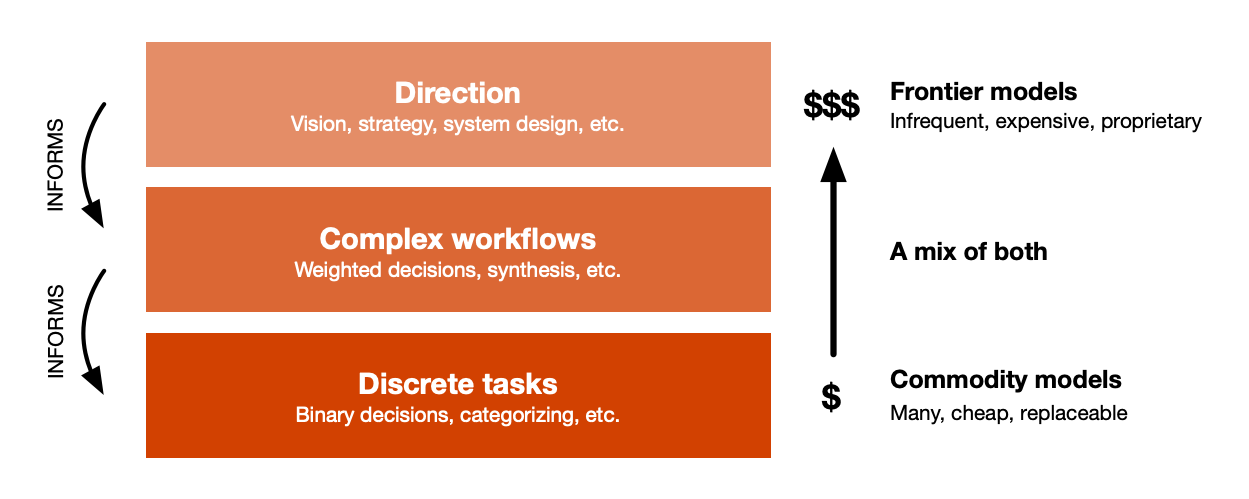
How do you determine the right mix of intelligences? Think of your AI operations as an “intelligence stack.” At the highest level, you have the vision and strategy for the system. At the bottom, you have particular one-off tasks that carry out system functions. In-between there are workflows with various degrees of complexity. All three levels call for different kinds of intelligence.
The goal is to bootstrap this stack by using expensive frontier models to design and implement the system and more commoditized models to operate it.
When developing the vision and strategy for the system, you’ll research competitors, build scenarios, and explore possibilities. These are open-ended tasks with uncertain outcomes; it’s hard to specify what good outcomes look like in advance. For this kind of job, you want the cleverest sparring partner you can buy.
The system you design to implement that strategy will include lots of frequent tasks that will likely require less clever models. For example, imagine your business responds to lots of RFPs. Each RFP must be triaged. Some will be a good fit, others irrelevant. Those that fit must be routed to the right people in the org, hopefully with draft suggestions on how to respond.
You could prompt a frontier model to analyze each RFP as it comes in, perhaps using a ChatGPT project or Claude Cowork space for context. But that would be costly. A better approach is to break down the process into discrete steps and assign particular tasks to models with lower capabilities. If you know what “good” looks like for each step (which is much easier to do at this level), you can architect model interactions for optimal performance in each step — much as you would when delegating tasks in the real-world.
This approach doesn’t just reduce costs, it also makes the system work more predictably. Without upfront architecture, frontier models must parse each task from scratch, leading to variance over time. A more structured approach can be tuned for the exact range of outcomes needed for each step in the process.
Because the system is modular, you can use different models at each step in the process. Higher-level tasks that require orchestration can use more expensive closed models, whereas granular tasks with predictable outcomes can use less expensive (or even free) models called from deterministic programs. You can also switch providers at various steps in the process, preserving optionality.
Using a mix of models also lets you adjust for latency. Some tasks require faster reactions than others. Smaller, less clever, models can often have lower latency than frontier models. And of course, you can also be more selective about what information leaves your network: open weight models running in your infrastructure preserve your privacy.
Sounds ideal, right? You use expensive (and proprietary) models sparingly to design systems that use cheaper, open models for the day-to-day. What’s the catch? It’s the same one we had before AI: you must define what “good” looks like beforehand and architect the system to deliver expectable results.
That’s not bad, as far as catches go. Thinking through your workflows will force strategic decisions. It makes more sense to automate some workflows than others, and some will be more critical to the business than others. Mapping and architecting the flows will let you focus on what matters.
Yes, architecture can be expensive and time-consuming. But frontier models make it faster and less expensive. (Thats part of the top layer of the stack.) They also allow us to make richer prototypes faster than before, reducing the risk of over-specifying complex systems upfront.
This modular approach can scale and improve as new models come in the market. Today’s frontier models will be tomorrow’s entry-level. When that happens, you’ll want to reconsider the mix. Whether you can will depend on how you structure your systems today.
How can craft help you gain traction? That was the question Harry and I explored in episode 41 of Traction Heroes.
I brought to the conversation a short reading from a book that had a big impact on my career, Chris Crawford’s The Art of Computer Game Design:
Games must be designed, but computers must be programmed. Both skills are rare and difficult to acquire, and their combination in one person is even more rare. For this reason many people have attempted to form design teams consisting of a nontechnical game designer and a non-artistic programmer. This system would work if either programming or game design were a straightforward process requiring little in the way of judicious trade-offs. The fact of the matter is that both programming and game design are desperately difficult activities demanding many painful choices. Teaming the two experts together is rather like handcuffing a pole vaulter to a high jumper; their resultant disastrous performance is the inevitable result of their conflicting styles.
More specifically, the designer/programmer team is bound to fail because the designer will ignorantly make unrealistic demands on the programmer while failing to recognize golden opportunities arising during the programming. For example, when I designed the game Energy Czar (an energy-economics simulation game), I did not include an obviously desirable provision for recording the history of the player’s actions. During the final stages of the game’s development, virtually everyone associated with the project suggested such a feature. From technical experience, I knew that this feature would require an excessive amount of memory. A nontechnical designer would have insisted upon the feature, only to face the disaster of a program too big to fit into its allowed memory size.
Another example comes from Eastern Front (1941). While writing the code for the calendar computations, I realized that a simple insertion would allow me to change color register values every month. I took advantage of this opportunity to change the color of the trees every month. The improvement in the game is small, but it cost me only 24 bytes to install, so it proved to be a cost-effective improvement. A nontechnical game designer would never have noticed the opportunity; neither would a non-artistic programmer.
This image of two handcuffed athletes greatly influenced how I understand design. Simply put, people without hands-on knowledge of a system’s capabilities and constraints shouldn’t be making critical decisions about those systems. (You can guess where I fall on the “should designers learn to code?” question.)
Of course, this applies to more than just designing software. Managers should understand how the organizations they manage deliver value — and not just in theory, but hands-on, on the field. The obvious challenge: delegation. You won’t be effective if you over-manage. But in today’s complex ecosystems, it’s easier to fall prey to abstraction than the opposite.
Where do you land on this spectrum? Please let us know in the comments on YouTube. (We’d love to build more of an audience there now that we’re sharing videos of the shows.)
We all work within intractably large and complex systems. How much agency do we really have? This was the question Harry and I explored on episode 40 of the Traction Heroes podcast.
Harry read a passage from Eric Ries’s new book, Incorruptible (which I haven’t read.) It starts by citing John Steinbeck’s story of depression-era farmers dealing with bank officers who’ve been rendered impersonal as agents of a large organization. Organizations are a kind of being:
Living things maintain boundaries between themselves and their environment, resources into energy. They grow, adapt, and reproduce. They exhibit behaviors that emerge from their parts but can’t be predicted by studying those parts in isolation. Most importantly, they display a will to survive that shapes every action they take. Organizations exhibit every one of these properties.
The organization is a superorganism that demonstrates emergent properties. Among these, is a kind of intelligence. This is the entity the farmers were interacting with through its agents.
We’ve all had experiences dealing with such complex emergent systems. One might feel disempowered when considering the organization forms part of a broader socioeconomic system that incentivizes it to act in particular ways.
Incorruptible sounds like an antidote to that kind of thinking. Our socio economic systems provide alternate structures and ways of being — and we can choose them: As Harry put it,
the default world that we’re in is just a construct. You really have an enormous amount of flexibility. You have many more degrees of freedom than you are probably aware of. It doesn’t serve the system to inform you of what those are because those degrees of freedom give you more control and give you more agency.
This conversation was empowering and energizing. As I said in the podcast, this book has moved up my queue — check out the show for more.
(On a separate note, this is the first episode we’ve released as a proper YouTube video. We’d love to know what you think — please comment in YouTube itself.)
]]>Jorge ArangoKinetic Coffee July 2026 Livestream2026-07-11T00:00:00-07:002026-07-11T00:00:00-07:00https://jarango.com/2026/07/11/kinetic-coffee-july-2026-livestream
The Kinetic Council invited me to join a panel with Abby Covert, Jessica Talisman, and Larry Swanson about the evolving role of information architecture in a world where AI exists. Things got salty! 🧂
]]>Jorge ArangoAfter Forty Years, Still No Silver Bullet2026-07-10T00:00:00-07:002026-07-10T00:00:00-07:00https://jarango.com/2026/07/10/after-forty-years-still-no-silver-bulletForty years ago, computer scientist Fred Brooks published a paper called No Silver Bullet: Essence and Accident in Software Engineering. As its title implies, the paper argues there are no technological shortcuts to making software radically easier, simpler, or more reliable. You may think AI is the ultimate silver bullet. It isn’t.
Moore’s law was in full force in 1986. Hardware was getting more powerful, faster, and cheaper. Surely, some technology would come along to do the same for software. Brooks argued this wasn’t in the cards, since software is fundamentally different from hardware. For one thing, it’s of a different order:
The essence of a software entity is a construct of interlocking concepts: data sets, relationships among data items, algorithms, and invocations of functions. This essence is abstract, in that the conceptual construct is the same under many different representations. It is nonetheless highly precise and richly detailed.
Specifying, designing, and testing this construct is difficult. The challenge isn’t implementation but design: “We still make syntax errors, to be sure; but they are fuzz compared to the conceptual errors in most systems.”
Technical advances usually make development easier. No Silver Bullet traces the history of time sharing, unified programming environments, and high-level languages. Object-oriented programming was a promising new technology at the time and there were even rudimentary AIs in the form of expert systems. Brooks examines them and concludes they’re not enough.
Why? Because coding isn’t the hardest part of making software. Instead, the hard part is knowing what to build:
The hardest single part of building a software system is deciding precisely what to build. No other part of the conceptual work is so difficult as establishing the detailed requirements, including all the interfaces to people, to machines, and to other software systems. No other part of the work so cripples the resulting system if done wrong. No other part is more difficult to rectify later.
What will the system do? How will it serve strategic objectives? How will it enable better judgment and allow people to derive meaning from data? These aren’t implementation questions, they’re design questions. Somebody must define the “construct of interlocking concepts” that define the system, aiming for good fit between the system and the context it serves. LLMs can help, but they can’t replace human understanding and judgment, at least not yet.
Brooks calls out four inherent properties of modern software systems:
Complexity: Software systems are among the most complex human constructs. They’ve only gotten more so as computers and operating systems have grown more powerful and capable.
Conformity: Software solutions must conform to the goals, needs, constraints, and interfaces of the organizations that bring them forth. This is true whether it’s bought off-the-shelf or developed bespoke.
Changeability: Anything that lasts does so because it’s able to adapt to changing conditions. Software is inherently more malleable than other complex designed systems, such as buildings.
Invisibility: Whereas complex physical systems (again, think of buildings) can be represented with mechanical drawings, software specs are inherently abstract. This makes them hard to design.
There’s been progress in the last four decades, but these properties remain fixed. LLMs haven’t changed that. Non-deterministic components add immense complexity and unpredictability to software systems. The ease, speed, and volume of code generation make software more malleable and opaque than ever. And LLMs promise to ease bespoke development, tempting orgs away from one-size-fits-all solutions.
Which is to say, LLMs haven’t changed the nature of software. Instead, they’ve made it more so. So far, the technology’s killer application is developing software: teams can now produce more software, faster. (It’s unclear yet whether it’ll ultimately be cheaper, especially when you consider maintenance costs.)
What LLMs haven’t done yet is replace software wholesale, at least not for tasks that require predictable behavior. And as their true costs and constraints become evident, it’s increasingly doubtful they will. Instead, LLMs will likely become part of systems that include traditional deterministic components — both inside the systems and as part of the development process.
The resulting systems will be more complex, malleable, and abstract than prior ones. They’ll also be better fit to purpose than off-the-shelf solutions. But that requires design, which remains primarily a human challenge. And it’s hard:
it is really impossible for clients, even those working with software engineers, to specify completely, precisely, and correctly the exact requirements of a modern software product before having built and tried some versions of the product they are specifying.
Replace “software engineers” with LLMs, and this sentence still stands. But it also hints at where LLMs come closest to being a silver bullet: in their ability to spin up rapid prototypes. Good software is grown, not built. That is, it evolves from an initial core to a more complex system through an organic approach that respects Gall’s law:
The building metaphor has outlived its usefulness. It is time to change again. If, as I believe, the conceptual structures we construct today are too complicated to be accurately specified in advance, and too complex to be built faultlessly, then we must take a radically different approach.
Let us turn to nature and study complexity in living things, instead of just the dead works of man. Here we find constructs whose complexities thrill us with awe. The brain alone is intricate beyond mapping, powerful beyond imitation, rich in diversity, self-protecting, and self-renewing. The secret is that it is grown, not built.
So it must be with our software systems.
What was true then is true now: technology moves the bottleneck from production to orientation. LLMs make coding easier, much like high-level languages, IDEs, and compilers did in the past. But without shared models, structured context, feedback loops, governance, and clear interfaces, they won’t provide the results leaders expect.
As always, how to build gets easier — knowing what to build doesn’t. AI can help with that too — but it needs steering. The question isn’t “Which systems can we replace with AI?” Rather, it’s “How can AI help us grow systems that better fit our needs?” The answer will consider AI as a system component and a production tool. But forty years on, there’s still no silver bullet — just better ways to find good fit, faster.
]]>Jorge ArangoTraction Heroes Ep. 39: Pace Layers2026-06-29T00:00:00-07:002026-06-29T00:00:00-07:00https://jarango.com/2026/06/29/traction-heroes-ep-39-pace-layers
AI lets us prototype faster than ever before. That’s great, as long as you remember there’s underlying work to be done. Specifically, production systems require structural underpinnings “screen-level” prototypes often miss.
Ironically, this means prematurely-rich prototypes can impede traction. So I wanted to discuss these issues with Harry. I kicked things off with a reading from Stewart Brand’s The Clock of the Long Now:
In recent years a few scientists (such as R. V. O’Neill and C. S. Holling) have been probing a similar issue in ecological systems: How do they manage change, and how do they absorb and incorporate shocks? The answer appears to lie in the relationship between components in a system that have different change rates and different scales of size. Instead of breaking under stress like something brittle these systems yield as if they were malleable. Some parts respond quickly to the shock, allowing slower parts to ignore the shock and maintain their steady duties of system continuity. The combination of fast and slow components makes the system resilient, along with the way the differently paced parts affect each other. Fast learns, slow remembers. Fast proposes, slow disposes. Fast is discontinuous, slow is continuous. Fast and small instructs slow and big by accrued innovation and occasional revolution. Slow and big controls small and fast by constraint and constancy. Fast gets all our attention, slow has all the power. All durable dynamic systems have this sort of structure; it is what makes them adaptable and robust.
This is a succinct articulation of pace layers, an important idea popularized by Brand. Complex systems are made up of diverse components and subsystems that change at different rates and scales. Resilient systems use the faster layers to experiment with new approaches and the slower layers to “remember” those best fit to purpose. Thus, the system evolves while maintaining coherence.
Brand showcased an early version of this model in his book How Buildings Learn: What Happens After They’re Built. As the title suggests, that version focused on explaining how buildings evolve. The model in The Clock of the Long Now casts a larger net, explaining how civilizations change over time.
Which is to say, this model can be generalized to other complex systems. That’s why it’s at the core of my book, Living in Information, where it explains how information environments remain resilient. That version offers five layers. Here they are, in order of fastest- to slowest-changing:
Form: the user interface
Structure: the underlying information architecture
Governance: how the organization manages change
Strategy: what the organization does differently to win
Purpose: why the organization exists
Pace layer model from ‘Living in Information‘
As with Brand’s version, the slower-changing layers are more powerful. But the fast layers also play an important role. A healthy system needs both. Therein lies the challenge: AI’s ability to produce rich prototypes can lead us to hang out too long on the fastest layer. Eventually, alignment and coherence require heading down the stack.
What’s exciting is that this isn’t a return to the slow old days. The same tools that can help us with form can help us with architecture and strategy. But they do require attention. You can start by asking yourself two questions:
What layer am I acting on?
What layer should I be acting on?
If there’s a misalignment there, you want to fix that first.
The form layer is easy now. And that’s great: it means we can better describe what we want. But you can’t leave it there. Somebody must look after alignment with the underlying layers — especially strategy, governance, and structure. That’s the work I’m increasingly doing, so it was great to discuss it with Harry.
]]>Jorge ArangoStill Holds: Gall’s Law2026-06-26T00:00:00-07:002026-06-26T00:00:00-07:00https://jarango.com/2026/06/26/still-holds-galls-lawComplex systems evolve from simpler systems. The ones that thrive do so because they’ve adapted to real-world conditions — and not because they were designed to address all possibilities.
In systems thinking, this principle was best articulated by John Gall:
A complex system that works is invariably found to have evolved from a simple system that worked. A complex system designed from scratch never works and cannot be patched up to make it work. You have to start over with a working simple system.
I’ve long promoted Gall’s law to students and clients. It’s been hard going. We want to see products and services in their full glory ASAP. But you can only throw so much cash and person-hours at a problem. Ergo, we got the time-tested idea of a minimum viable product. (It’s no coincidence that orgs with more resources violate Gall’s law more often than scrappy startups.)
But the value of an MVP isn’t just that it allows you to get something that works quickly and cheaply. Instead, the value is that that first try isn’t overspecified to theoretical conditions. It’s only a draft meant to kick off an evolutionary process that leads to a system that meets real-world customer needs.
AI removes these constraints. An afternoon with Claude can yield a comprehensive spec for a very complex system. Further sessions can architect the system and build an initial release that includes bells, whistles, timpani, harps, violas, and all the other instruments in the orchestra. All this, at a fraction of the cost and time it would’ve taken in the past.
That’s amazing. It means we can now design and build much larger systems, faster. This opens new possibilities. Not just one new feature, a new product. Not just a new product, a suite. Not just a suite, a platform. The possibilities seem endless.
But in removing architecture and development constraints, we’re also removing the need to focus on what matters most and the discipline to run it by the market. All that upfront complexity doesn’t necessarily address real-world needs. Instead, it reflects a singular top-down vision that may or may not provide value to others.
Whereas MVPs in the “before times” called for minimal investment before validation, LLMs promise a much more realized vision from the first go. But there’s a significant difference between a sexy concept car and a vehicle customers will take grocery shopping. AI-augmented workflows will give you the former, but not the latter.
Here’s an example. Two years ago, I started building a product called SiteRanger, an AI-powered agent to help small teams manage large websites. This was before Claude Code or any of the current coding agents. Still, I got surprisingly far by using Claude to augment my basic PHP skills.
Together, we built a functional MVP that implemented what I considered to be the core functionality. The problem: my “core” was in fact an open-ended platform. Rather than solve a particular customer problem, it was designed to solve classes of problems.
By the time I got alpha users on board, the system was wildly over-architected. Worse, I learned new agentic systems could provide ~80% of its value. When I looked to pivot, I realized I’d have to move in a completely different direction, one with entrenched incumbents. It wasn’t worth it.
It wasn’t all a loss. This experiment taught me a lot about developing AI-powered software products using AI. But the most important lesson I learned is that AI makes it very easy for individuals and small teams to land in the same trap as resource-rich orgs: no constraints.
Which isn’t to say you shouldn’t use AI. To the contrary, I’m all for accelerating MVP design and development. But the word “viable” is fungible, especially when you have robot engineers. You want to expose the product to the discipline of the market. That means releasing something embarrassingly simple at first. And that requires discipline and constraint — the two things most scarce when working with LLMs.
My friend Karl Fast pointed me to a wonderful scene in the movie A RIVER RUNS THROUGH IT. The main character, a child, brings an essay to his dad, a strict preacher, for evaluation. The dad’s only reply: “Half as long.” The child does, and returns with the edit. After scribbling with a red pencil, the preacher looks at him and says: “Again, half as long.”
Step away from the console and ask yourself: What would I cut if there were no AI building it? Cut, cut, cut. Then imagine Tom Skerritt staring at you over his schoolmaster glasses and saying drily, “Again, half as long.”
]]>Jorge ArangoBecoming a Principle-Driven Leader2026-06-18T00:00:00-07:002026-06-18T00:00:00-07:00https://jarango.com/readings/becoming-a-principle-driven-leaderCharles Koch is on a mission to foster more principled behavior in the world. He’s written several books on principle-based management, and co-authored this one — the first I’ve read — with his son Chase. The goal: help businesses, societies, and individuals thrive by adopting a principle-based mindset.
The key distinction is between management through principles and top-down management by rules. The latter is impracticable because managers aren’t omniscient. Arbitrary constraints proliferate in such a system, leading to stasis and entropy.
How do you keep things moving in the right direction without proliferating rules? By infusing the organization with principles. The book showcases 41 that made the Kochs successful, including Integrity, Openness, Property Rights, Mutual Benefit, Personal Knowledge, Stewardship and Compliance, and more.
Some of these are more obvious than others. Sidebars throughout the book highlight each principle as the authors narrate stories from their careers that exemplify how their organizations infused a principled culture, stayed ahead of change, out-competed other organizations, influenced policy, contributed to the broader well-being, and more.
The book starts by suggesting it’ll unfold from the perspective of both Charles and Chase, who also works at Koch Industries. But apart from a couple of autobiographical chapters at the beginning, most of the book told from a unified POV. (It’s clear Chase has internalized his father’s worldview.)
The two autobiographical chapters comprise the first part of the book, which is about applying principles to transform your life. The second part is about transforming your business. The final part is about transforming society. It applies the Koch’s principles to thorny social and political issues.
Business books often gloss over mistakes to elevate the authors. This one doesn’t. The Kohns own up to numerous mistakes, including one that cost the lives of two teenagers. Rather, they often own up to their companies’ managers’ mistakes, something I found a bit off-putting. Still, the message is clear: principled decision-making helped them get ahead — and they got in trouble when eschewing such principles.
The world would be better if principled people were in charge. I happen to agree with most of the principles in this book, but IMO the broader point is driving change through clear and well-grounded principles rather than top-down rules that constrain human agency. In promoting this mindset, this book provides a blueprint for building a more harmonious, adaptive, productive, and fair world.
It’s stunning how often simple safety checks were not carried out on tractor-trailers that subsequently crashed. Things that could have been fixed easily. Human error or judgment is not usually the cause of the collision, but rather it is the driver’s failure to make simple routine checks he should make every time he gets behind the wheel to make sure his truck is safe as possible and he won’t needlessly endanger the public. These checks usually take only five or ten minutes before the driver gets behind the wheel of the truck.
Of course, I wanted to probe further. How do these checklists come about? Are they provided by experts? Compiled from firsthand experience? Both?
In any case, this is actionable knowledge — and it can make an important difference. In the absence of checklists and standards, individuals and teams can “drift into failure,” inching toward catastrophe. Success calls for mindfulness and continuous vigilance.
What can you do besides compiling checklists? You can conduct post-mortems after something happens. Perhaps more usefully, you can also conduct premortems before projects begin. Both post- and premortems can inform checklists.
Good leadership calls for clarity, intentionality, and accountability. Establishing routines and standards — and staying on top of them — can help avoid failure.
]]>Jorge ArangoOpen-Ended Sessions: The Job Brief2026-06-09T00:00:00-07:002026-06-09T00:00:00-07:00https://jarango.com/2026/06/09/open-ended-session-the-job-brief
In the third of our Open-Ended Sessions, Greg and I discussed how AI is changing how product and design work are done. In particular, we’re tracking the shift from feature- and screen-level work to more strategic and human-centered system design.
Lots of orgs are choosing to deploy AI as a means to do more of the same, only faster and cheaper. But AI can also be used to unlock new possibilities by augmenting (rather than replacing) humans.
As Greg put it,
The efficiency play can be in service of unlocking human potential, right? So they don’t have to be either-or paths, but they do have to be both at a minimum.
Ultimately, the key question isn’t what the technology is capable of, but what it’s for.
Greg: Oh my gosh, yeah. You know, I think when we were talking about perhaps hosting one of our sessions here, it was really about the zeitgeist, like what’s happening this moment. And there are these peaks where all of a sudden there’s some kind of thread that shows up that just begs to be probed. So thanks for encouraging me and us to have these conversations. And for those who are joining us, welcome to number three of our Unfinishe sessions, where Jorge and I just talk about stuff that we think is interesting that’s going on. And we hope you find it valuable as well.
Jorge: Yeah. And it might be worth recapping beyond the open-ended conversations. This is not just something that we’re doing because we want to talk about things that interest us. In some ways, it feels like the transformations that we’re seeing are, sounds kind of heavy-handed to say it, but they’re existential. They kind of are. And these conversations I see as an opportunity to name the things we’re seeing. You have your note taker just joined when he’s trying to join. You see, it is existential.
Greg: That’s right. There we go. Goodbye.
Jorge: It might be worth unpacking what that means, but we have not pre-scheduled these, to your point. We’re kind of calling these conversations when we have sensed a shift in the zeitgeist. And this is the third one we’ve had so far. And I’m going to try to sketch out the conditions that precipitated this one. And then we’re going to circle back to a post that you shared, which I see as kind of like a way to deal more skillfully, for organizations to deal more skillfully with the situation that they find themselves in now. But there are several factors at play here. One is the big shift toward the end of last year. I think we saw a big shift in how people in general are thinking about AI. Agentic software development tools like Claude Code started proving their mettle in the organization, right?
Greg: Yeah.
Jorge: And Simon Wilson recently had a blog post where he said that Anthropic and OpenAI have found product-market fit. And he was referring specifically to these tools, right? So there’s been this shift from a modality that is more focused toward software development. And then we have things like Claude Code that build on that agentic way of working with these systems. So that was a big shift toward the tail end of last year. And then I would say that around the end of the first quarter of the year, we started paying the piper, literally. Organizations have started realizing that that kind of usage can get very expensive, right? And we’ve started to see some organizations start to pull back, capping their people’s budget for using these tools.
Greg: I would just build. I’ve been working as a fractional for a couple of different companies, fractional design leader, for those who haven’t heard that term before, over the last year. And to watch how product organizations have started to use these tools, and then the uptake in them, and then the capabilities that they unlock, and then the speed that teams can work at, and more importantly that you can do more, it’s been really remarkable to watch. And at the same time, it’s causing all kinds of churn because teams are struggling with who does what, how, when, and they’re hitting some of these issues too around utilization and use of the tools and the cost of using the tools, and not just the financial cost of using the tools, which can be significant when teams burn through their tokens, but the cognitive costs of using these tools, because you can build incredibly dense, rich, powerful documents now, but then your peers have to have time to consume them. And one of the things I’m noticing is that many of us are collaborating with our AIs more than we are collaborating with each other. And so there are all these kinds of things that we’re learning in the process of using these tools. And I also think there was some hyperbole around what was going to happen and how this might change things and the number of people, etc., that I think is starting to not show up. I think there are some things that we can think about that are different. So in this moment, yeah, we saw toward—
Jorge: Beginning of the year, organizations were starting to boast of how many tokens they were using, and they had leaderboards for this stuff.
Greg: Yeah.
Jorge: Which is another factor here that I think the emphasis was clearly on adoption as opposed to value creation. And one of the things that has shifted is, well, first they’ve stopped doing that because I think they realized, like, hey, this is really expensive. But also, that’s no way to measure progress, right? What you want to do is you want to be actually creating value. You don’t want to be boasting of how much you’re using the tools, right? So it feels like we’re kind of speed-running the process of maturing into how—
Greg: These tools can serve human needs. Yeah, there’s a whole set of new problems that are showing up inside product organizations around utilization. Are you using the right model? Are you leaving your context window open too long and therefore every time you ask for something you’re burning through credits like mad? Did you budget appropriately for the amount of credits that your team is using? What does finance think about all of that, right? I think there’s a whole bunch of things that are popping up right now. And some of that showed up in some recent announcements with Microsoft deciding to turn Claude off inside of their environment. There’s been conversation about bringing their own code development tools and their own models to bear, so maybe that has part of it. But I also, from what I understand, they were spending a lot of money. And my own experience in watching the team that I’ve been helping, the startup that I’m working with, is we run out of credits on a regular basis, or tokens on a regular basis. And then we have to go and ask for more. And there’s no real governance or process in place for a small company where they’re kind of making it up as they go and trying to understand what it means. They want to go fast, and so they’re willing to spend the money, but they have finite resources. So they can’t spend as much as they maybe think they should, or as the team wants to spend potentially. And there are all sorts of stories around teams that have burned giant holes in the budget of their organization by doing things which may not have been valuable, right? And it goes back to your point around this leaderboard thing. And I think one of the things that there’s a really great post by Hepburn about the cost of being busy that I think is really interesting to me. It was really about the teams that give the tools so that AI can be adopted throughout the organization and people sort of adopt them at their own speed are not really getting all that much productivity gain. They’re getting richer content perhaps, but they’re not institutionalizing the work in a way that takes the work that’s repetitive or less of priority and maybe building agents around that so that you can unleash your people towards new things. And I think there’s another aspect of this, which you and I started, I think this is one of the reasons why I wanted to talk this week, was Pope Leo’s encyclical came out, and it kind of fits a notion that we’ve been talking about for Unfinishe, our practice, which is we want to help organizations discover how they can, you know, the possibilities of unleashing their talent towards new efforts versus a productivity gain where you’re laying people off because you don’t need them anymore, right? I think it’s a very different mental model. And I think that there’s something about this conversation that needs to come up around the humans in the system and the value that these tools create for us, but also the value of work, etc., that I think is a notional, the conversation’s happening now and that’s good. And I think that document was a really important document to come out. And there’s been a lot of conversation around it. I know you have a take on it, but some people will leave it at that and hear what you think.
Jorge: Yeah, and I’m glad you brought that up. And even though this is turning into a kind of long preamble, I also want to bring to the table the conversation that you had with Cindy Chastain on her podcast.
Greg: Yeah.
Jorge: Because that conversation also circled around some of these issues. And I’m going to try to name it, just hearing you talk about it. I’m going to try to name the connecting thread for all of these things that we’re observing. And the thread is the question: but what is it for? It’s like, what are we doing with this, right? What’s the point? The conversation with Cindy, one way to summarize it might be something like: for design and product teams, there are two possible things that you can do with this. You can approach it as a way to do the things you were doing before more efficiently, faster. I don’t know if more cheaply, as is becoming evident, but do, let’s say, more with fewer people, right? Or another possible approach you could take is you could take this as an opportunity to do more with the people that you have, or maybe even with more people in your team, right? Just empower them to explore possibilities that were previously unattainable because of the natural constraints of a team of humans and their limited cognitive abilities and attention. And I wanted to bring that up because, A, I think that we, well, I’d love to hear your take, but I think that we’re both in the second camp. It’s like, hey, let’s see how we can augment people to do more. Because one of the things that motivates us in our shared practice is possibilities, like opening a broader space of possibilities, right?
Greg: Yes, I think with possibilities, intention, like what future do we want to have and how do we help teams and organizations fulfill that in an intentional way? And I love that you brought that up because I think the conversation that Cindy and I had was really about two stories. I’ve been doing this fractional work, and over the last year I’ve worked with two different companies, and sort of not at the same time, too. So one was sort of last year to the end of last year, and the second one is I’m currently engaged with and I started with in January when all these tools started to mature. And there are sort of two conversations. The first one was sort of dabbling with AI, learning how to use the tools, some experiments with vibe coding, etc. The second one was the design team and the product team not only using those tools, but exploring whole new territories that we just didn’t have time for in the past to do. So we were imagining a new product capability, a new product category for a company, not a pivot, but an expansion of this particular organization’s remit that they want to serve. They had a really good idea of a set of problems they wanted to solve. And we just did things that were just hard to argue for in the normal timeframe that software development gets built. And we were able to do them. So we did a bunch of work on information architecture. And one of the things that we did is we looked at competitive tools that were out there, other people trying to solve the problem in similar ways, and we did really deep analysis of how they structured their experiences so we could try to understand why they were doing it. And that helped inform a better architecture for us. We did a bunch of work looking at agentic systems and emerging conversations around how to build MCP apps. And that was exploratory. Frankly, I think it’s exploratory for everyone who’s working in that area. And so we were able to help use the process of making to define the product requirements. And in some ways, we were leading product development in that conversation because we were really trying to understand meaningful outcomes. And we came up with this thing we called the job brief, and it worked for us very well. So I think the opportunity right now is to build much better products. The concept of an MVP to me is sort of like something that needs to be reexamined because most MVPs were always insufficiently great because they were constrained by time and engineering resources. And now, where engineering resources are less constrained, why do we put product into the market that isn’t foundationally awesome? And so we can do that. And I think there’s an opportunity to really ask the organization to rethink how it takes the time of their customers and fulfills their needs and their goals. And we can be much more clear and more polished and build things which on launch make people feel seen, the users of them feel seen in a way that we couldn’t do before. And so I think that to me is an inkling of what these tools should be doing. And that’s just a product development example. But I think you could do this for organizational change. And I think any organization could take a look at it and say, I don’t just want productivity. I want to unleash the creativity of my people towards new outcomes. And that’s the kind of work I want to work on. I think it’s the kind of work that you want to work on. And it’s the kind of work that I think that the Pope’s encyclical talks about, which is meaningful work and placing humans in the system and not just this sort of technocratic cost-out perspective.
Jorge: Yeah. There’s been a, well, you wrote a post about this and I want to get into the post.
Greg: Yeah, sure.
Jorge: The very title of the post has the phrase, “The feature is dead.”
Greg: Yeah.
Jorge: Which is kind of provocative, right?
Greg: Yeah, sure.
Jorge: Why is the product feature dead, Greg?
Greg: Well, I think we’re designing something different now, right? Feature was a component, a widget, a tool that helped humans solve a problem. And in the traditional way of product development and user experience, the actor was the user, right? The user’s on a journey. You build a capability for them to complete a task that’s important for them. They use that tool. They get it done. And so product development would think in increments of capability, features. That’s what we call them in product. And we would build those features in support of customers accomplishing their goals that were important to them on their adventures at work. And what’s changed now is we have this intelligence that we’re working with. And it can be the actor, right? It can make the choices and decisions on the process, especially when you think about more agentic workflows. And so the notion of product discovery and creating and making is different. We’re not making a widget or a tool. I mean, those are still important, and by the way, yes, thank you for calling out it’s a provocative title. Features don’t disappear; they still are important. But I think what’s more important is encoding the intelligence in a system so that it can support humans and their goals, but also allow some autonomy for agents to do things. And that’s a new skill, a new pattern. And the way I was thinking about it is Clayton Christensen coined this term jobs to be done. And jobs to be done is sort of evergreen. It doesn’t go away. You have to balance your checking account or you have to pay, make payroll, or you have to answer a customer call. But the way that you can do that can change over time with the way technology shows up or how an organization chooses to solve that problem. And ironically, a lot of organizations don’t actually really understand what they do. They’ve built sort of Rube Goldberg machines of technology that allow them to accomplish tasks, and individuals in the organization are actors in that to solve a business problem. But very few people in the organization actually understand the outcomes and business goals that an organization is trying to solve for. So I’ll give you an example. The reason why this came up is there’s also something very different in the way that we can build software right now, where it’s more structural and more of a system and less bespoke custom feature development. So this particular startup that I’m working with, we are building a system that can add new capabilities, and we wanted those new capabilities to show up almost like a feed of content, right? The application would be much more like Spotify, where you’d have a playlist of things that you can, instead of a playlist of things you listen to, a playlist of things that you can do. But to do that, then you have to kind of understand, like, what do those things do and why are they valuable and how do they achieve outcomes that are important for the end user or the company that’s buying a product or a service. And so we built this thing. I’m calling it a job brief. It’s a little bit of a hybrid. It’s influenced a little bit from the Josh Seiden sort of outcomes over output construct, being an outcome-centric notion. But what I wanted to do is try to create a recipe. And I built this sort of recipe card. You can’t really see it here, but I’ll share this with folks if they’re interested. And it was really very straightforward: find the job. What is the problem? Sit with a practitioner or a person at work and find out what is the thing that they need to accomplish. Write a job statement, one sentence: who’s the user, what are they trying to do, whether they want to know or decide. Don’t make it about technology at all. What’s the outcome that they’re trying to get to? And then the next layer, which is new, I mean, this is something we’ve done forever, but the next layer is what is the context that we understand in the system? What data do we have access to? Where is the user or the person who’s acting in a moment in their day, in their workflow, in the ebb and flow of an organization? You have to define what done means. When the job is completed, what does success look like? And then the last part of it is really understanding what expertise is around that. And working with people who have deep knowledge of what that outcome should look like, what’s meaningful for an organization. And I would argue that for every organization, that expertise might be different based on the values of that organization, the people they have, the things that they find important. And this is an opportunity to add that human layer into what differentiates company A from company B. Don’t just use a novel solution that everyone uses. Build something that’s respectful of what’s important to you as an organization. And then finally, the last part is find some way to measure it by how often it’s used, by invocation, like how often it gets done. And so that construct is really about understanding how humans in the system work. Now, I’m not naive. Some of this work turns into agents that do the work for you. And ideally, in an organization, you could use this as a way to look at the things in your organization that you can codify, the domain expertise, to gain productivity and to gain efficiency where you can. But my next point of view on that is in service of being able to do more interesting, more valuable work that pushes your objectives farther forward. And so that’s the notion behind it.
Jorge: This is all in the context of design and the projects that you have been working on. You’ve been working, your role has been like a fractional chief design officer, right? So you’ve been leading design teams. Another one of the signals that we are picking up from the environment is that it feels like many organizations are questioning the value of investing in design.
Greg: Yeah.
Jorge: And I was thinking, there was a time when a lot of organizations did not have big design teams internally, right? The idea that design is a function of the organization, I would say at least the current wave, because there have been prior ones, but the current wave, we can probably date back to around 20 years ago after it had become clear that Steve Jobs had saved Apple through design, right? And people were upholding the iPod as an example of a well-designed product. And there are still business leaders out there who are thinking in terms of, like, I want something that is as useful, beautiful, whatever, as the iPod, right? So it became like a touchstone that articulated the value of design for organizations. And that seems to have shifted significantly as a result of AI. And I suspect that it might not be coincidental that Jony Ive and company’s latest product to hit the market has not been well received by a lot of people. I’m talking about the new Ferrari.
Greg: Yeah, right.
Jorge: And I have no, you know, I’m not an expert in that space. I’m not a Ferrari fan or anything. To me, it looked like—
Greg: I lost your audio. Oh, no. I can’t hear you. Now I can.
Jorge: Okay, great. What I was saying: I am not a Ferrari fan, so I don’t have as strong feelings about that product as other people. But it did strike me that at least a lot of the commentary I saw online, I got the sense that it felt like this, like it was over-designed or like it’s precious. Or it’s like it’s a product that is trying to make design, like it’s a design-forward thing. And in some ways, that almost hurt it because it feels like it’s a rethinking of what a Ferrari is supposed to be. And I almost found it to be like a metaphor for what’s happening elsewhere in design. It’s like, I guess the question is: is design necessary now that there’s a Claude design and Figma will do design work? And I think that I’ll stop after this. I think that a lot of organizations have built design functions that are primarily production functions.
Greg: Yeah.
Jorge: And by production, I mean they are set up basically to crank out screen-based experiences.
Greg: Yeah.
Jorge: And they have staffed up with people who are tasked with doing that kind of work. And at least to me, it’s been pretty clear that that’s going away, and it has been clear for a while, right? The tools have been getting better. The kind of design work that you’re talking about when you talk about job briefs. You said that the jobs-to-be-done construct is evergreen. And I think that one of the reasons it’s evergreen is because it moves the level of abstraction. It’s not about how do you execute on the hole in the wall. It’s about how do you determine what it is that the customer needs. And then you can figure out how that’s delivered to them, right? And I’m wondering, I’m just, again, this is open-ended and unstructured, right? So I’m thinking out loud here. I’m wondering if what we’re seeing is a shift from an understanding of design as this kind of screen-level production function to, and then there’s a question mark. And I think that your article tries to answer that question by saying to a role that is more strategic, which is something that designers have been trying to do for a while with not a lot of traction, I would say.
Greg: Yeah, many haven’t. Yeah, there have been some examples of people who have, but yes, you’re right. Let me respond to it. I think when we build products, there are different roles that are really important. And I think when design is seen as only craft and only as screen building, it misses the value that design can bring to the table. Those things are important, but they’re not the only thing. And the challenge is that at some level for many people in many organizations, the AI tooling is capable of doing, I wouldn’t say excellent, but reasonable results on the sort of production-level quality of building a user interface. However, I think one of the things that designers bring to the table is a deep understanding of human behavior and building products that recognize humans in the system and the mental models that people have. And it’s connected to empathy. It’s connected to having the ability to do ethnography, basically sit with customers and understand how they solve problems and what they’re trying to accomplish. It requires some new skills now because when we look at the capabilities of these tools, you can incrementally make things better or you could radically change things. And it doesn’t mean one or the other is the right path. It’s actually what is the right path for the group of humans that you’re responsible for delivering a solution for. Too much change may require a group of people to do things they’re just not unwilling to do or unable to do cognitively. Not enough change is a missed opportunity toward functionally changing the game in a way that produces some really interesting results for an organization or for the people who work in the organization. And we’re in this really messy period where the old rules don’t really apply and people are trying to apply the old rules. So you still see PRD, product requirement documents. You still see engineering burndowns. You still see JIRA tickets created. You still see, this is a software development process, because people anchor to that. That’s what they know. They kind of organize around it. But it’s unclear to me if that process of how we built software is still usable and useful in this new moment. And there’s an opportunity to change that. So where am I going with all this? I think designers bring a couple of skills to a team that are really valuable. And if not there, it’s a missed opportunity for organizations. And they can be very strategic. We are adept at the art of juxtaposition. We can take two different ideas and put them together and discern a net-new outcome. Because we make the think, we make things, we make artifacts, and those artifacts inform us. And that conversation we have with the things that we make allows us to find truth or an answer or a solution or a novel way of solving a problem in a way that can be faster than other methods. It’s not the only way to solve those problems, but it’s a super valuable way to do it. So that’s kind of just one path that designers take. The second part of it is I think it is my personal perspective that it’s inexcusable that you don’t make things great now because the tools let us do that. And that requires discernment. That requires someone who can look at a small radius or a small curve on a user experience or looking at accessibility and making sure that a product is useful for all of us, regardless of our abilities. That we can choose words carefully so that it aids people in the direction of the path that they’re trying to take. We don’t just build a piece of software and expect them to learn how to use it. We can now frame a product in a way that fits the mental model of the people that we’re serving, and we can actually get closer and closer and closer to that because these tools allow us to actually iterate and understand that more successfully. So I guess a long way of saying is I think designers are very important. There are some new things that we have to look out for, like I think interfaces are starting to collapse. We’re doing more of our work in language models, right? We’re speaking with AI. We’re having a conversation with AI. AI systems can not only answer words, they can answer in interfaces, so they can create custom experiences for us or custom tools for us in the conversation. You could just do that. But I think the thing that design brings to the table is an intentional way of doing it, shaping the grammar of an organization, inserting a value set of values into an organization, shaping how answers are delivered. Are they long? Are they short? What’s the structure? What’s the organization of them? Left alone, a large language model may choose to answer a problem differently every time you ask it, and that may not serve the audience that you’re trying to serve, right? So I think there’s a role for design to be very much involved in intentional curation of these experiences and bringing human values into them explicitly. I remember, I’m forgetting who told me this. I’ll think of it in a moment. But all software has opinions in it, whether they are explicitly or implicitly embedded in the software. Some teams are very explicit about it: this is what we do, certain things. Others, it’s just the end result of the people who built it and what they valued. But it’s there, right? We have an opportunity to be very explicit about how we serve people. And again, I think design is the discipline that not just solves business problems but figures out ways to make it deeply human. And I think our opportunity is to help organizations at a different layer, at a different level. And it may not be screens we’re working on. It could be orchestrating the flow of how work happens in a way that makes sense for people. And that’s a new skill. Not all designers are going to pivot or understand how to move into that space. But I think the things that we bring to the table are very useful there. Anyway, that—
Jorge: Was a long answer to your question. Well, and it kind of prompts some follow-up questions. You said earlier in the conversation, and I’m going to be—
Greg: I lost you there for a second there, Jorge. I think your internet took a—
Jorge: Yeah, something’s glitchy. Can you hear me?
Greg: I can hear you now, yes. I wanted to repeat your question or insight.
Jorge: Yeah, so you said, I’m going to paraphrase and probably get it wrong, but you said something earlier in the conversation along the lines of one of the things that we’re grappling with, and this was talking about as designers, is the fact that many of the things that we were doing as humans working with tools are now being delegated to agentic systems, right? And I’m going to put on my CEO hat, right? Like I have to make, I have to determine how I’m going to invest, how I’m going to allocate the organization’s capital, right? And there’s a lot of incentive right now for organizations to invest in capability, like technical capability, right? Compute is what they’re calling it, right? And you said that one of the things that designers bring to the table is a deep understanding of human behavior. Yeah. But if the systems that we’re building are not going to be used by humans, why does that matter? If I’m a CEO looking to invest, what’s the argument in favor of investing in a design team that is going to be crafting experiences to be used by humans? When, hey, isn’t AI going to do all of it? Why am I investing in human experiences?
Greg: Well, I mean, that’s a great question. I think if you’re a cost-out CEO, that may be what you think about, right? You’re like, I don’t need a design team. We’re going to use all these tools, and we’re going to deliver this service with as few people as possible. And we’re going to look at generating as much revenue as possible. And this is a path for us to get there. And my guess is there’ll be many parts of our economy that are going to be efficiency plays like that, that are going to be things that people are worried about from a job perspective. And it’s sort of inevitable. However, I also think that there will be a group of CEOs that have a growth mindset who look at what their organization does in their community or wherever they serve and look for opportunities to provide better services or better outcomes or better products. And I think one of the things that’s missed is there’s this bottom-up and top-down conversation that’s missed. So as an example, I think small organizations benefit massively from these tools because they allow them to punch way above their weight so they can compete at levels that they couldn’t compete with before. And small, intimate teams with these tools that communicate well with each other now have the ability to expand their horizons around the things that they can offer, the services they can develop, the things that they can provide for whoever their customers are, or users are, or whatever their goals are, whether they’re for-profit, not-for-profit, etc. In large organizations, I think the transition is going to be identifying also where in the aspect of the services that they provide that humans are actually important for their customers, right? So I think as humans, people want to hang out with people, right? And I mean, there are people apparently who have chat, cheap, and girlfriends, but I think most of us are, especially even post-pandemic, and I still think we’re in the post-pandemic phase, we want to have a sense of community and connection to each other. And so I think there’s huge opportunity for organizations that recognize how to place their people front and center with their customers or the people that they care about or the things that are important. So I guess what I’m trying to discern is I think there’s an opportunity space for the people who are good at unlocking possibilities and discerning new things to service, developing better outcomes for all of us. And it’s a little bit of a, you know, it needs to be seen, but I think that’s the path that I want to see. I would love to see our politics in this world focus on the opportunity to service and support everyone. I’d love to see our businesses look for opportunities to grow their businesses in new and creative ways. And I would love to see human potential be the big story about being unlocked by these tools versus being laid off. And I think we need to think about that very hard. I think we need to find this is going to be a transition. There’s not going to be without, there already is massive transformation going on in organizations. And I think we are, as a culture, need to be managing this carefully. And again, I’ll come back to why I think design is important, because I think designers can find opportunities to potentially mitigate some of the challenges with AI, from an employment and cultural perspective. But they’re also just going to be great at finding new things to do that we didn’t know we needed before and that are exciting and fun and fulfilling and helpful. And so, if I were a large CEO, one of the things I would be investing in is a creative design team that is just exploring and looking for net-new things that could benefit, that are adjacencies to a company’s core mission that might be new growth opportunities for them. And I think that the tooling allows creatives the opportunity to really shine there. I don’t think we’re there yet. I don’t think people have talked about it yet enough. But I do think that there’s really an opportunity for us to look for ways to be more future-focused and actually try to tackle some of the real problems that we have in the world.
Jorge: I kind of want to double down on what you’re saying there, because in playing devil’s advocate earlier, it may not have been clear just how much I agree with what you’re saying there. But my read is that organizations that are kind of restructuring themselves to maybe, like a phrase that you could, maybe a phrase we could use is something like a post-design world, or like a world in which they’re not placing their emphasis on human experience, right? The organizations that are investing in AI as a way to gain efficiencies by automating the sort of touchpoints that humans have relied on so far, they’re doing so from what I see as like a, like in my mind, I have this Venn diagram that has fear, bad incentives, and a kind of like spectacular lack of imagination. Yeah. The phrase that often comes to mind is this Warren Buffett thing where he says that he advises being bold when others are fearful and fearful when others are being bold. And I just want to kind of double down on what you said about this being a time of unique opportunity, particularly for the organizations that are willing to zag where everyone else is zigging in the direction of efficiencies. Just because there are, like to your point, there are now possibilities that were just previously unavailable. And to only think about the path of, like, how can we make, how can we deliver the minimum possible experience as cheaply as possible is one possible direction, but by no means the only one, right? And I suspect that we are still in the throes of, like, hey, this is a new technology and let’s double down on efficiencies where we have not yet truly explored the possibilities of other ways of using the technology, right?
Greg: Yeah, I mean, I love that framing. I’ve been a big, one of the things I’ve talked about for the last 10 years is this notion of incrementalism versus really understanding the problem, right? And for a lot of organizations, incrementalism was the path towards success because you took small pieces and you got better and you got better over time and you got better over time. It kind of fits the Agile Manifesto. It’s how organizations work. They’re risk-averse, so they don’t want to try to take on too much. We’ll make one small change, we’ll make a change of, you know, and. But it was connected to the fact that things were very difficult to do well, and therefore you had to be careful about doing it. And so instead of going for it and doing something big or trying an experiment and failing, you just made your product slightly better over time or your outcome slightly better over time, your system slightly better over time. And there’s nothing wrong with that as a strategy, by the way. It makes sense and allows you to do things in a sustained way. What is interesting about this moment is that these tools allow us to build things that used to be very, the very expensive part of building software is far less expensive than it used to be. And so an incrementalist mindset may just be a faster way to get to the wrong place, you know? And I think one of the things that we don’t do enough of is discovery work, understanding what is the problem and what would really be meaningful for people. And now we can spend a lot of time in that, right? And in the design space there’s this diagram called the double diamond that came out of the British Design Council that’s a very popular way of describing the process of design. And the first half, the first diamond, is discovery. And then you sort of evolve that into a product, and then you go into an execution phase, and then you deliver and you learn from your customers. And my argument now is that these tools allow us to build the first part of that diamond much bigger and the rest of it much smaller. And what do I mean by that? It means that we can spend, in a short period of time with these tools, we can learn way more about who we’re serving and have a much better understanding of what their problem is and iterate on not just one, but hundreds of solutions that could possibly satisfy those needs and outcomes, and then discern which one is the best, refine it, make it great, and then deliver it at fairly low cost from an execution standpoint. And so that upends the process. It used to be the other way around, that the execution part was so hard that that’s where all the energy was, right? And so it was like, make a small bet, get it out to market, make another small bet, make it out to market. So it goes back to your point of lack of imagination. And I think there’s an opportunity right now for companies to at least have some part of their organization that is thinking boldly and broadly and unhampered by an incrementalist mindset. And I think if I were a CEO of a larger organization, I would be setting up a lab to think about not how to use these tools to do what I do better now. I would be setting up a lab on how do I use these tools to do something I’m not doing now that would help me grow my outcomes that are important to my shareholders or to my customers or to the business community that I’m trying to connect to.
Jorge: I love that framing.
Greg: And I think designers are great at that. They’re not the only one. There need to be other parties in that conversation. It’s a multidisciplinary effort, but it doesn’t work without designers in the room.
Jorge: You know, to circle back to the Pope’s encyclical, the central metaphor that he uses to talk about the possible ways forward for the development of AI-based systems, he uses this architectural analogy from using two stories from the Bible. One story is the construction of the Tower of Babel, which is a kind of technocratic, top-down effort to, now I’m kind of reading into it, right, to control. And it’s an effort that kind of flattens differences between people. And he contrasts that with another story from the Bible, which is the rebuilding of Jerusalem after it had been torn down. And he talks about Nehemiah. I don’t know if that’s how you pronounce it, but this person who rather than dictate top-down this technocratic solution, gathered the people who inhabited the city. And through this kind of consultative approach, led to the rebuilding of this kind of organic, more organic city that responded to their needs. And part of what I’m hearing you say is that, and I think that this is also implicit, if not explicit, in the encyclical, is that AI allows for both of those approaches. We can do the top-down thing really fast now and really comprehensively, and it can turn into a real dystopia. Or we could employ it in this more kind of bottom-up, consultative, human-centered way, and it could also do it much faster with greater scope, with the possibility to explore many, many more alternatives just because the tool allows us to do so much more. So it becomes a matter of how do you choose which of the two approaches you’re going to take? And I think what we’re saying here is we would like to foster a world that follows the second path, the more kind of designerly path, the path that puts human beings, their needs, including their dignity, which is an important word in the encyclical, front and center. And the tools are amazing. They can empower us to do much more than before, as long as it’s in service of that, right?
Greg: Yeah, creating a better world. And the irony is you can have both of those things happen. The efficiency play can be in service of unlocking human potential, right? So they don’t have to be either-or paths, but they do have to be both at a minimum. If we just go the Tower of Babel path, I don’t want to live in that future. I’m very much interested in being intentional about the choices that we make. And again, that’s why I go back to why designers are important. We’re good at that. We are good at intentionally helping craft a narrative and artifacts and things which connect to the way that we want to live. And then we’re good at telling stories around that with the things that we create. Those things that we create inspire people. And it’s a really part of being human that there are things that delight us and bring us joy and make us cry and help us understand and live fulfilling lives, all the things that I think are important, which by the way, that’s not the longest list of important things, but nonetheless, I think we’re coming to a close.
Jorge: I was going to say that feels like a good place to wrap it up. If you want to follow our work, we do have a Substack. It’s called Unfinishe Thoughts, and it’s at thoughts.unfinishe.com. Remember, it’s Unfinishe without the D. And Greg and I post there periodically. It feels like almost as infrequently as we do these live streams, but we should write these things up more.
Greg: Yeah, our plan is to be a little bit more prolific in the rest of this year. But thanks for hanging out with us today. And Jorge, as always, I love hanging out with you and talking about our stuff. And we’ll see you at the next Unfinish.
Many teams are being measured for the wrong things: tokens used, agents deployed, etc. Their orgs have focused on tech adoption rather than value creation. It’s a mistake.
I wanted to discuss this with Harry in our most recent podcast, so I read a passage from one of my favorite books, James C. Scott’s Seeing Like a State. To my surprise, he’d read it too.
I won’t cite the whole passage, but it kicks off with a familiar distinction:
Isaiah Berlin, in his study of Tolstoy, compared the hedgehog, who knew “one big thing,” to the fox, who knew many things. The scientific forester and the cadastral official are like the hedgehog. The sharply focused interest of the scientific foresters in commercial lumber and that of the cadastral officials in land revenue constrain them to finding clear-cut answers to one question. The naturalist and the farmer, on the other hand, are like the fox. They know a great many things about forests and cultivable land. Although the forester’s and cadastral official’s range of knowledge is far narrower, we should not forget that their knowledge is systematic and synoptic, allowing them to see and understand things a fox would not grasp.
Scott then unpacks how flattening an ecosystem to a few legible variables leads to a kind of myopia. This is assuming the variables are meaningful, as with land productivity for cadastral purposes. Token maxxing, on the other hand, is folly.
Legibility — instrumenting processes so we can track progress — is essential for traction. But we shouldn’t focus on things we can measure (e.g., tokens used, numbers of agents created) rather than those that matter to the business.
It’s harder to focus on the right measures when we’re acting urgently and/or from fear, as is the case for many teams now. How can we measure what really matters? That’s what Harry and I explore in this episode.
]]>Jorge ArangoMagnifica Humanitas2026-05-29T00:00:00-07:002026-05-29T00:00:00-07:00https://jarango.com/readings/magnifica-humanitasEarlier this year, I talked with a newly-minted theology MA about the relationship between AI and spirituality. I suggested Pope Leo XIV might have something to say. With the publication of the encyclical Magnifica Humanitas, he’s said it.
The Pope’s namesake, Leo XIII, led the Church during the second half of the 19th century. It was a time of social unrest triggered by technological changes: the Industrial Revolution precipitated the exploitation of workers and its counteraction in Marxism. Both dehumanized societies.
The Church’s response was Rerum Novarum (1891), an encyclical that promoted both the rights of workers and free markets. It offered a sensible middle path between anything-goes capitalism and atheistic socialism, and set the foundations for the Catholic Church’s modern social positions.
In choosing the name Leo XIV, the current Pope hinted at continuing this work. It’s certainly needed: digital technologies — and AI in particular — are at least as transformative as industrial machinery. The central question is, how will we use this technology? Will it serve the common good or dominate and exploit people?
These aren’t technical questions: they’re moral and spiritual. The Catholic Church has grappled with such issues for centuries, and Magnifica Humanitas offers an overview of that history, warts and all. The outcome is a comprehensive social framework based on several key principles:
The common good. Work toward social well-being collectively, not by aggregating individual interests.
The universal destination of goods. Don’t monopolize wealth and resources; steward the goods that create well-being for all.
Subsidiarity. Delegate decision-making authority to the smallest possible unit.
Solidarity. Recognize that our destinies are bound together and we have obligations toward each other.
Social justice. Be fair and don’t exploit or discriminate against people. (Again, everyone has inherent worth.)
Integral human development. Elevate people so they can participate with dignity in society.
After recapping the Church’s Social Doctrine, the encyclical applies these principles to AI and the digital economy. We can choose how to design these technologies. The Pope describes two possible approaches by using architectural metaphors drawn from scripture. One is that of the Tower of Babel: a construct meant to glorify its dominator-builders and homogenize people for the sake of power and efficiency. The other is exemplified by the lesser-known story of the rebuilding of the walls of Jerusalem:
Nehemiah, a Jew in the service of the Persian King Artaxerxes, received news of the disastrous state of his ancestral city. Before taking action, he fasted, prayed and interceded for the people. He then asked the king for permission to return to Jerusalem and, upon arriving, examined the destroyed areas in silence. He did not impose solutions from above. He convened the families, assigned each of them a section of the wall to rebuild, listened to their concerns, coordinated their efforts and addressed any opposition.
Which is to say, an organic, consultative process with the people affected — as opposed to a top-down technocratic initiative. The former responds to the needs of members of the community. The latter imposes “solutions” from above, eroding their agency. Upholding human dignity is the encyclical’s foundational principle, and it’s under threat:
It is important to ensure that this growth in appreciation of human dignity is not obscured by the pressure of new ideologies or very powerful interests in today’s world. Among these ideologies, I consider particularly insidious the one that suggests that every person must earn or justify his or her own worth, to the point of attributing greater value to those who are more efficient or effective. From this perspective, persons end up being reduced to a means of achieving results, a resource to be used and exploited, and are no longer recognized as a proper end in themselves who should never be instrumentalized. The value of persons, however, does not depend on what they achieve or produce. There are rights that apply to everyone simply by virtue of being human, and no human power can legitimately deny or arbitrarily limit them.
Like all technologies, digital systems are shaped by the values of the socioeconomic systems that create them. Systems that prioritize domination and personal gain over the common good pose serious risks, including growing inequality, weakened democracy, increased social unrest, environmental degradation, the emergence of new forms of slavery, and more.
And of course, there’s the ever-present risk of violence. Autonomous weapons threaten new levels of destruction. War takes a new valence when the systems deciding on the path of death aren’t human:
Artificial intelligences do not undergo experiences, do not possess a body, do not feel joy or pain, do not mature through relationships and do not know from within what love, work, friendship or responsibility mean. Nor do they have a moral conscience, since they do not judge good and evil, grasp the ultimate meaning of situations, or bear responsibility for consequences. They may imitate language, behavior and analytical skills, or even simulate empathy and understanding, but they do not understand what they produce, for they lack the affective, relational and spiritual perspective through which human beings grow in wisdom.
But Magnifica Humanitas is less an AI manifesto than a commentary on (and corrective of) the socioeconomic systems under which it’s emerged. Instead of systems that treat people as means to particular ends (e.g., Marxism, extreme forms of capitalism), the Pope calls for building a civilization of love grounded on justice, human rights, and basic decency.
In issuing this encyclical, the Church stakes a clear moral position. It isn’t an argument against technology, private property, or free markets. Instead, it’s a reasonable call to treat humans and our labor with dignity:
In the era of artificial intelligence, when human dignity is threatened by new forms of dehumanization, ours is the pressing duty to remain profoundly human.
You needn’t be Catholic to recognize the importance of this message. Ultimately, the question of how we’ll put AI to use isn’t technical, but moral. The stakes — human dignity, democratic participation, the distribution of power — couldn’t be higher.
]]>Jorge ArangoThe Case for Augmenting (Not Cutting) People2026-05-27T00:00:00-07:002026-05-27T00:00:00-07:00https://jarango.com/2026/05/27/the-case-for-augmenting-not-cutting-peopleAs a child, I had an unhealthy relationship with food. One day, after promising to not overeat, my mother caught me at the fridge, gorging on cheese. Her words stayed with me: “You may think you’re lying to me, but you’re lying to yourself.”
We do that a lot, lie to ourselves.
I don’t like making predictions, but I’ll make one now. I’m confident it’ll pan out: organizations cutting staff “because AI” will come to regret that choice.
That’s not to say I believe that’s why they’re actually laying people off. Many orgs were likely overstaffed. AI is just the excuse leaders are giving Wall Street. Perhaps some believe it. If so, they’re lying to themselves. And there will be consequences.
As the class “fat kid,” I was bullied. It affected my personality. I became simultaneously shy and viciously sardonic. My grades suffered. I’m still paying the price for the fridge “easy fix” decades ago. Near-term pleasure, long-term suffering.
Orgs cutting staff are being rewarded with a near-term financial boost. What might be some long-term consequences?
I see at least three:
Reduced trust. The people who remain still have work to do. That includes deploying AI, a technology they now viscerally perceive as a threat. They’re damned if they do and damned if they don’t. And their leaders have made clear what they value.
Brand erosion. Wall Street isn’t the only audience: customers are listening too. And they’re likely (and rightly) concerned that the org seeks to replace human judgment. We’ve been burned before: that’s why the word ‘enshittification’ exists.
Loss of culture and knowledge. Much of how organizations produce value isn’t formally codified. In many ways, an org is its people — their shared culture and knowledge, most of which is tacit. The data AI needs about how orgs tick doesn’t exist.
Humans aren’t mere resources. Organizations are complex adaptive systems where people play critical roles that extend well beyond their job descriptions. For many orgs, interpersonal relations are the golden egg-laying goose.
Current AI can’t bridge these gaps. Leaders who believe it can are either deluded about its capabilities, the true nature and complexity of the business, or both. Or they’re lying to themselves.
My mother was right. You may think you’re cleverly misdirecting others, but you’re only misdirecting yourself. And the consequences will haunt you.
I’ve been pretty glum on this note, but that’s because I don’t like what I’m seeing. So I’ll leave you with the positive flipside of my prediction: The organizations that thrive in the AI era will be those who augment and empower their people — not those who cut them.
The technology is capable, but it will require lots of work. The challenge is architecture, not headcount.