
Smart businesses are realizing they don’t have to blow their budgets on frontier AI. At least, that’s the conclusion of a recent article in the Wall Street Journal. Models come in different levels of cleverness, and the “smartest” cost more. But not all tasks require the highest level of intelligence. A mix of models will give you the biggest bang for your buck, at the expense of upfront architecture.
The Journal cited an excellent example:
Cursor recently ran an experiment to evaluate the cost of building a web browser from scratch. Doing the entire task on OpenAI’s GPT-5.5 cost a little more than $10,000. Using Cursor’s Composer coding model in combination with Anthropic’s Opus 4.8, cost $1,339.
The focus here is cost, but that’s not the only concern. The most intelligent models — those offered by frontier labs such as Anthropic and OpenAI — are closed and proprietary. That has implications for your business. For one, you risk becoming dependent on others for critical cognitive tasks — a strategic and privacy risk. If a provider can turn off the intelligence spigot (or, more likely, raise its price) you’re stuck.
The solution is breaking down jobs into tasks that can be done by a variety of models. Some tasks, such as planning, will require more powerful models. But many others can rely on cheaper, less powerful models. Open weight models are becoming a commodity: not only are they cheaper but also mostly interchangeable. Not happy with how a model is performing at a particular task? Switch it out.
This is how business has been organized forever. Some jobs require greater expertise and capabilities than others. For example, neurosurgery can only be successfully done by a very small number of people who have the necessary intelligence, training, and experience. On the other hand, cleaning the operating room can be done by someone with less training, expertise, and smarts. Hence, neurosurgeons earn more.
How do you determine the right mix of intelligences? Think of your AI operations as an “intelligence stack.” At the highest level, you have the vision and strategy for the system. At the bottom, you have particular one-off tasks that carry out system functions. In-between there are workflows with various degrees of complexity. All three levels call for different kinds of intelligence.
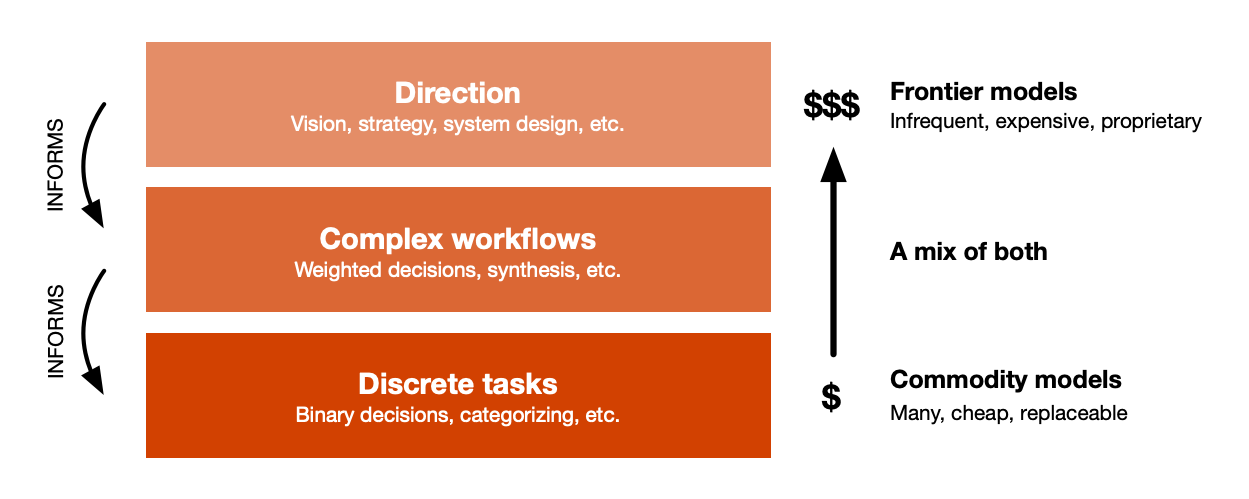
The goal is to bootstrap this stack by using expensive frontier models to design and implement the system and more commoditized models to operate it.
When developing the vision and strategy for the system, you’ll research competitors, build scenarios, and explore possibilities. These are open-ended tasks with uncertain outcomes; it’s hard to specify what good outcomes look like in advance. For this kind of job, you want the cleverest sparring partner you can buy.
The system you design to implement that strategy will include lots of frequent tasks that will likely require less clever models. For example, imagine your business responds to lots of RFPs. Each RFP must be triaged. Some will be a good fit, others irrelevant. Those that fit must be routed to the right people in the org, hopefully with draft suggestions on how to respond.
You could prompt a frontier model to analyze each RFP as it comes in, perhaps using a ChatGPT project or Claude Cowork space for context. But that would be costly. A better approach is to break down the process into discrete steps and assign particular tasks to models with lower capabilities. If you know what “good” looks like for each step (which is much easier to do at this level), you can architect model interactions for optimal performance in each step — much as you would when delegating tasks in the real-world.
This approach doesn’t just reduce costs, it also makes the system work more predictably. Without upfront architecture, frontier models must parse each task from scratch, leading to variance over time. A more structured approach can be tuned for the exact range of outcomes needed for each step in the process.
Because the system is modular, you can use different models at each step in the process. Higher-level tasks that require orchestration can use more expensive closed models, whereas granular tasks with predictable outcomes can use less expensive (or even free) models called from deterministic programs. You can also switch providers at various steps in the process, preserving optionality.
Using a mix of models also lets you adjust for latency. Some tasks require faster reactions than others. Smaller, less clever, models can often have lower latency than frontier models. And of course, you can also be more selective about what information leaves your network: open weight models running in your infrastructure preserve your privacy.
Sounds ideal, right? You use expensive (and proprietary) models sparingly to design systems that use cheaper, open models for the day-to-day. What’s the catch? It’s the same one we had before AI: you must define what “good” looks like beforehand and architect the system to deliver expectable results.
That’s not bad, as far as catches go. Thinking through your workflows will force strategic decisions. It makes more sense to automate some workflows than others, and some will be more critical to the business than others. Mapping and architecting the flows will let you focus on what matters.
Yes, architecture can be expensive and time-consuming. But frontier models make it faster and less expensive. (Thats part of the top layer of the stack.) They also allow us to make richer prototypes faster than before, reducing the risk of over-specifying complex systems upfront.
This modular approach can scale and improve as new models come in the market. Today’s frontier models will be tomorrow’s entry-level. When that happens, you’ll want to reconsider the mix. Whether you can will depend on how you structure your systems today.
This post first appeared on unfinishe_ thoughts.