On week 49 of the humanities crash course, I explored three thinkers who’ve influenced the present moment: Simone de Beauvoir, Michel Foucault, and René Girard. In the case of the first, I read selections from The Second Sex. The other two were interviews. I also watched a classic film that straddled the silent and talkie eras.
Readings
I only read the introduction and first chapter of The Second Sex, so I won’t attempt to summarize beyond that. De Beauvoir’s goal is clear from the outset: she’s looking to debunk culturally accepted notions of “femininity” as a way of keeping women down.
The book’s first chapter takes a deep look at biological differences between males and females of various species. De Beauvoir highlights the fact that while these differences are real, they don’t imply hierarchy. Rather, there is a symbiosis between the sexes.
The Foucault interview appears in a collection called Power/Knowledge, where it’s titled The Eye of Power. Foucault examines Jeremy Bentham’s Panopticon, a facility (e.g., a prison) where inmates can be continually monitored by centrally located forces. The spatial configuration encourages prisoners to self-regulate, since they can’t tell when they’re being watched.
](/assets/images/2025/12/bentham-panopticon.jpg)
Plan of Bentham’s panopticon prison drawn by Willey Reveley (1791) via Wikimedia
Foucault’s point: the design of a space can be a technology of power, helping authority manage not just movement but communications and hierarchical perceptions. The panopticon becomes a metaphor for how institutions turn people into subjects by combining power and knowledge. As GPT 5 mini put it: “observation generates data, data become expertise, and expertise refines techniques of discipline.”
The Girard interview, titled Why Do We Fight? How Do We Stop?, appears in a collection called Conversations With René Girard. To my surprise, it’s an episode of a podcast I’ve listened to many times, Robert Harrison’s Entitled Opinions.
The topic of the conversation is human conflict and whether religion helps or hinders it. Girard’s position is that conflict stems from two people coveting the same thing, which causes others to covet as well. The tension is eventually resolved through scapegoating: a member of the community is sacrificed.
This scapegoat mechanism serves as the foundation of all major myths, up until Christianity, which makes it explicit (and therefore stops it.) As Girard puts it,
If we had more genuine religion, we would have less violence. This is what most ordinary people still believe, and, as a rule, when the ordinary people and the intellectuals do not agree, it is safer to go with ordinary people.
This seems like a good primer for Girard’s thinking. I’m basing this understanding on my having read a book about his work called Wanting. Much of this thinking resonates with me; I’m planning to delve more deeply over the next few years.
Audiovisual
Music: three essential American signer-songwriters: Woodie Guthrie, Joan Baez, and Bob Dylan. I’d heard a lot of Dylan and some Guthrie, but it was my first time listening to Baez. I liked her music and have added a couple of her songs to my regular rotation.
Arts: two painters I already knew well: Roy Lichtenstein and Andy Warhol. I fell down a Warhol rabbit hole in college, leading me to learn screen printing. His star has waned since: I now find him more interesting than his work. (He would’ve been at home in social media!)
](/assets/images/2025/12/lichtenstein-industry-and-the-arts.jpg)
Industry and the Arts (II) (1969) by Roy Lichtenstein by Fineartcollector1 via Wikimedia
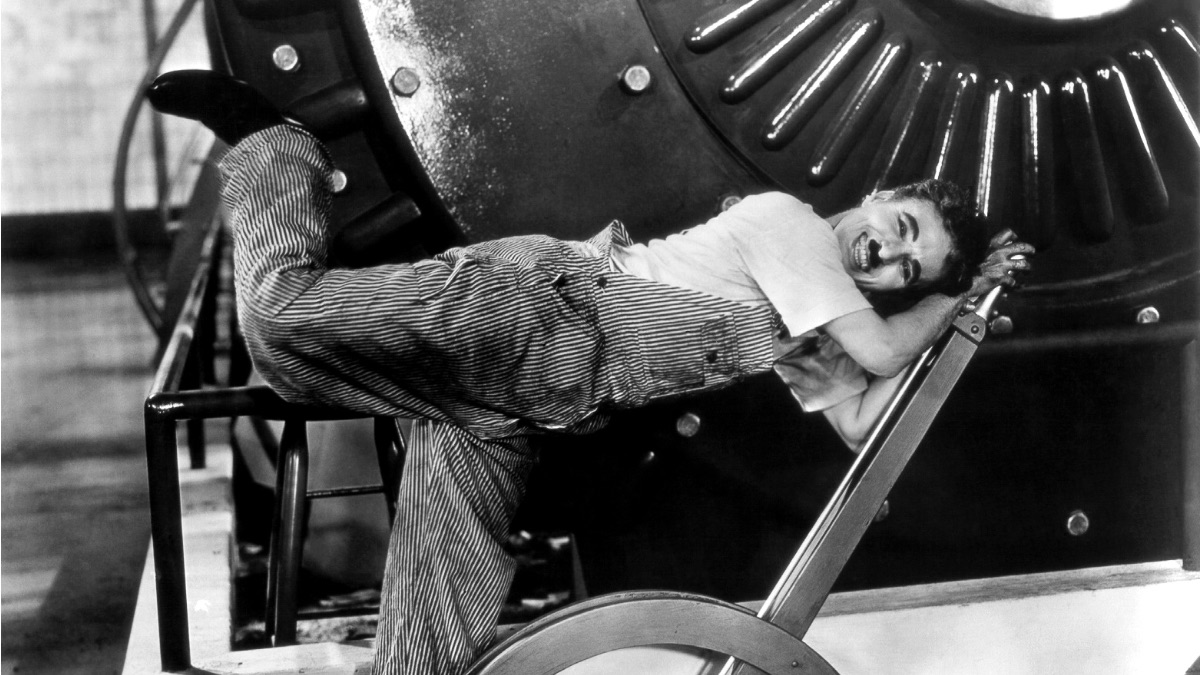
Cinema: Charlie Chaplin’s MODERN TIMES (1936), a statement against the dehumanizing aspects of industrialization.
Tis last outing of Chaplin’s Little Tramp character deals with inhumane working conditions, unemployment, and injustice. Some scenes (e.g., the worker feeding machine) are a savage critique of “efficiency at all costs” culture.
I was surprised to learn that this film is only partially a talkie, given it’s so late. (THE JAZZ SINGER predates it by almost a decade.) The choice was intentional: Chaplin recognized the character’s effectiveness depended on pantomime.
Reflection
I chose MODERN TIMES on a whim. Later, I learned Sartre, de Beauvoir, and Merleau-Ponty named their journal after the film. This bit of serendipity highlights one of the common threads this week: how to maintain human dignity and agency amid huge impersonal systems.
Foucault examines how systems — institutions, cultures, organizations, etc. — create conditions that constrain individual agency. De Beauvoir challenges cultural understandings of femininity that constrain women’s agency. Girard plumbs the mechanisms underlying mass actions — imitating, coveting — which are another means for losing individual agency.
Guthrie, Dylan, Baez, and Chaplin also advocate for humanity, albeit through other means. Rather than have us think about these deep issues in new ways, their work makes us feel differently. In Chaplin’s case, it’s humor and pathos. For the singer/songwriters, it’s a broader range of emotions.
As for this week’s painters, they subvert mechanistic systems in different ways. Warhol he called his studio “The Factory” and used industrial means to create potentially endless reproductions of his paintings. Lichtenstein simulated halftone patterns by hand. These painters, poets, academics, and filmmakers all looked for humanity amid large, dehumanizing structures.
Notes on Note-taking
This week, ChatGPT helped me revise a longstanding misunderstanding. I consider Marxism a deeply corrosive ideology, and have long dismissed Chaplin because of what I perceived to be his Marxist sympathies.
MODERN TIMES’s opening sections only reinforced this impression. The Tramp is cast as a beleaguered worker in contrast with the factory’s manager — ostensibly, a capitalist — who is nicely dressed, fed, and leisurely. (He’s shown solving a jigsaw puzzle in his office while his workers run around manically in the assembly line.)
Shortly after, Chaplin’s character is unwittingly drawn into a communist march, where he’s arrested after being mistakenly perceived as the mob’s leader. Throughout the movie, workers are shown as sympathetic characters, even when they’re committing crimes. There’s a strong pro-union undercurrent throughout.
One must always consider the context when looking at works of the past. Here, the key factor is the Great Depression. When this movie was made, many Americans were suffering from what were broadly understood to be market failures. The grass is always greener, and the horrors of the Soviet system hadn’t yet been made public. So I thought it understandable that the “Everyman” — which Chaplin channeled in the Tramp — would have Marxist leanings.
There’s irony in that when this film was being shot, millions of people were enslaved by the Soviets, some in conditions similar to the ones Chaplin parodies in the film. Except there, they had no recourse. Worse, a filmmaker who dared shoot something like these scenes would likely himself be shot (metaphorically, if not literally.) But neither the audience nor director knew that at the time.
Anyway, as I watched the film, I cringed at what I perceived to be Chaplin’s naïve politics. Afterward, I asked ChatGPT to disabuse me of these impressions in an intentionally provocative way:
I just watched “Modern Times”. My take: it’s thinly veiled Marxist propaganda — and ironically, it came out at a time when the Soviets were treating their citizens in exactly the way Chaplin criticizes in the movie. How is this assessment wrong?
I’m not going to quote its full response, which was a somewhat long. The upshot: the LLM gave me a nuanced and convincing defense of Chaplin’s position, which changed my mind. Its explanation consisted of five points, whose title I copy here verbatim with my summary of each:
- Chaplin wasn’t a Marxist — and the film isn’t promoting revolution. While left-leaning, Chaplin was not a doctrinaire Marxist. Instead, “His worldview is more humanist than ideological: concerned with dignity, individuality, and kindness over systems.”
- The film critiques industrial modernity, not capitalism as a system. The movie’s target isn’t a particular socio-economic system, but “the mechanization and regimentation of modern life.”
- The irony about the USSR doesn’t hit as squarely as it seems. My “ironic” read is anachronistic: “Soviet labor conditions were largely unknown in the West until the late 1930s and 1940s.”
- The film’s comedic form resists ideological rigidity. Ideologues tend to be hardasses; propaganda “needs coherence and seriousness,” which comedy undercuts.
- Chaplin’s Tramp embodies non-Marxist values. The character is essentially an individualist and romantic. He’s not looking to join or support a movement. Au contraire, he values personal freedom and dreams of owning a private home with the girl he loves.
This final point is especially compelling. The film would indeed look very different if it was “thinly veiled Marxist propaganda”: the Tramp isn’t exhorting anyone to overthrow the bourgeoisie — if anything, he aspires to a bourgeois lifestyle himself!
Instead, ChatGPT offered the following summary of how to best understand MODERN TIMES after stripping away ideological lenses:
- A Depression-era critique of runaway industrialization
- A humanistic plea for compassion toward the vulnerable
- A transition point between silent and sound cinema
- A slapstick exploration of how individuals stay human in dehumanizing systems
It sits closer to Thoreau, Dickens, and early American progressivism than to Marx and Engels.
This strikes me as a fair read. I came out the other end of this chat with more than a different appreciation for Chaplin: if my biases led me to misread the movie, what about a writer like Foucault? This brief interaction opened my mind to new possibilities for understanding. It’s ironic that some contemporaries cast AI — which helped me better understand efforts to combat dehumanizing technologies — as a dehumanizing technology.
Up Next
Gioia recommends a few selections from Susan Sontag, Walter Benjamin, and José Ortega y Gassett. Again, more theory — but I expect these are up my alley. I’ve already read one of the Sontag essays and enjoyed it. This is gonna be fun!
Again, there’s a YouTube playlist for the videos I’m sharing here. I’m also sharing these posts via Substack if you’d like to subscribe and comment. See you next week!