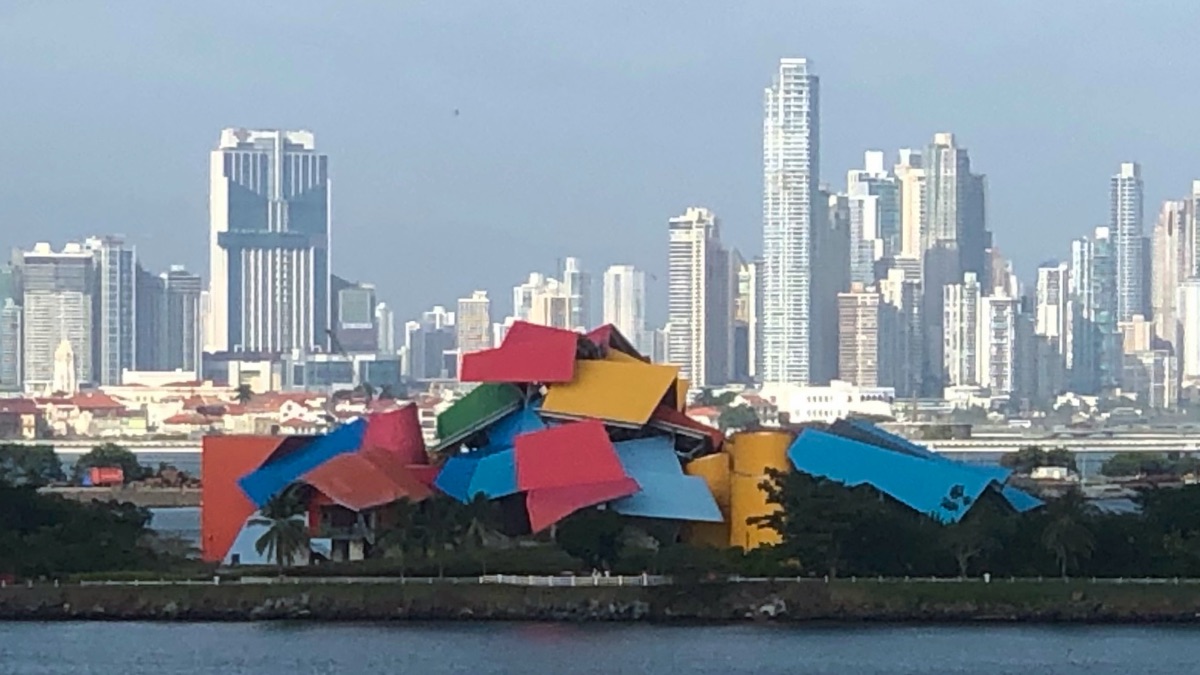
Frank Gehry died yesterday, so I thought it timely to outline three lessons I learned from his work. Before I get into it, a bit of personal context. I did some early web design for Biomuseo, the only Gehry building in Latin America, and briefly met the man himself when he gave a presentation in Panama. But his influence on me goes back further, to when I was an architecture student.
Back in the late 1980s, Gehry was becoming famous after two decades of working in relative obscurity. His buildings were everywhere — at least in all the glossy magazines. One of my early school projects entailed designing an exhibition for his work. I focused on materials and color. His unconventional use of the former was especially inspirational. And here we come to the first lesson…
Lesson 1: Quality ≠ Expensive
Until then, chainlink and corrugated steel were not “respectable” building materials. His Santa Monica home was a middle finger confidently hoisted at his suburban neighbors: one hated the house so much he had his dog poop on its yard. Gehry called his approach a “cheapskate aesthetic” — an opportunistic punk rock architecture inspired by the work of artists like Robert Rauschenberg.
](/assets/images/2025/12/gehry-residence.jpg)
Photo of the Gehry Residence in Santa Monica by IK’s World Trip via Wikimedia
Gehry would move on from cheap materials as his star rose, eventually becoming known for buildings clad in titanium. But his early work expanded my understanding of what was acceptable. To use Eno’s framing, he extended the materials axis for architecture. That it expanded toward affordability was a bonus, since it made more possible with less. I’ve applied this lesson elsewhere: quality needn’t be expensive.
Lesson 2: Let Technology Expand Possibilities…
The second lesson comes from how digital technology changed his work. Architecture is always influenced by (and sometimes influences) technological changes. For example, elevators with electrical motors made skyscrapers possible. Gehry’s best-known buildings — the Bilbao Guggenheim museum and the Walt Disney Concert Hall — would be impossible without computers.
](/assets/images/2025/12/guggenheim-bilbao-aerial.jpg)
Try drafting this using traditional straightedges and pencils. Aerial view of the Bilbao Guggenheim museum by Mikel Arrazola - EJ-Irekia via Wikimedia
In particular, Gehry adapted aerospace CAD software for use in architecture, making possible the design and fabrication of buildings with sinuous curves and unusual construction techniques. He recognized that software opened new design possibilities, but also new lines of business: the work spun off Gehry Technologies, a software-and-consulting company.
The lesson here is twofold. On one hand, be open to new possibilities afforded by technology — and not just in implementation, but in design, too. This lesson is especially relevant now that AI is transforming both how we design software and software itself. On the other hand, helping others achieve similarly transformational results might produce a synergistic line of business.
Lesson 3: … But Use It Mindfully
The third lesson is cautionary. Before I proceed, I’ll admit that I stopped paying attention to Gehry as my career drifted towards web and software design. That said, my outsider impression is that as he became famous, clients sought him out not to solve “practical” architectural problems but because they wanted a Gehry building: a landmark urban intervention that would do for their organization/community what the Guggenheim did for Bilbao.
The results were sometimes impractical. For example, MIT sued his firm for problems with his Stata Center building and some of the Disney Concert Hall’s skin had to be sanded down to reduce glare. And of course, the famous Bilbao museum has been justly criticized for eclipsing the art inside.
](/assets/images/2025/12/stata-center.jpg)
Photo of the Stata Center at MIT via Wikimedia
Gehry’s boundary-pushing redefined what was possible for architecture. But the old adage applies: that you can doesn’t mean that you should. Yes, software makes possible buildings without straight lines, right angles, or repeatable modules. But there are good reasons why buildings have had all three for a long time: the alternative can be both expensive and impractical.
Will They Deliver Value Over Time?
Beyond near-term practicality, there’s the issue of adaptability. Their unusual forms make Gehry buildings less malleable in the Stewart Brand sense. Again, I’ll reference Eno, who distinguishes between architects and gardeners: the former design immutable structures to be built as-specified, whereas the latter design and steward structures for emergence and growth.
Gehry is squarely on the “architect” end of this spectrum, alongside other “immortals” like Frank Lloyd Wright. Future generations will likely admire their buildings more as works of art with particular imprimaturs — a Gehry building, a Wright building — than as functional spaces that adapt to changing needs.
](/assets/images/2025/12/lou-ruvo-center.jpg)
Photo of the Lou Ruvo Center by Monster4711 via Wikimedia
Early in my career, I identified with the “architect” side of the spectrum. But experience has taught me there’s more value in gardening. Things that can evolve can better stand the test of time — and the longer they last, the more value they deliver. Traditional forms and structures are often more sustainable and practical than those that upend the status quo.
To map this onto UX, AI is likely leading into a period of wild experimentation as designers and engineers vibecode previously unimaginable experiences. Most will be better demos than practical systems: people still need recognizable contextual cues for sense-making and navigation. Technology may enable cool new information environments, but that won’t mean they’ll be useful or usable.
“Gardeners” aspire to learn where new technologies expand possibilities usefully and scalably — i.e., transcending individual and temporal preferences. We look to adopt new technologies mindfully, finding how they might enable experiences that add value to peoples’ lives — and not just our contemporaries, but future users and stewards too.
This isn’t to denigrate “architects,” especially the experimental variety. Understanding what’s possible requires people who push boundaries and commandeer tools, materials, and techniques for unexpected ends. We need folks who reset our expectations and set new standards, even if they’re sui generis. Gehry was one of the best.